
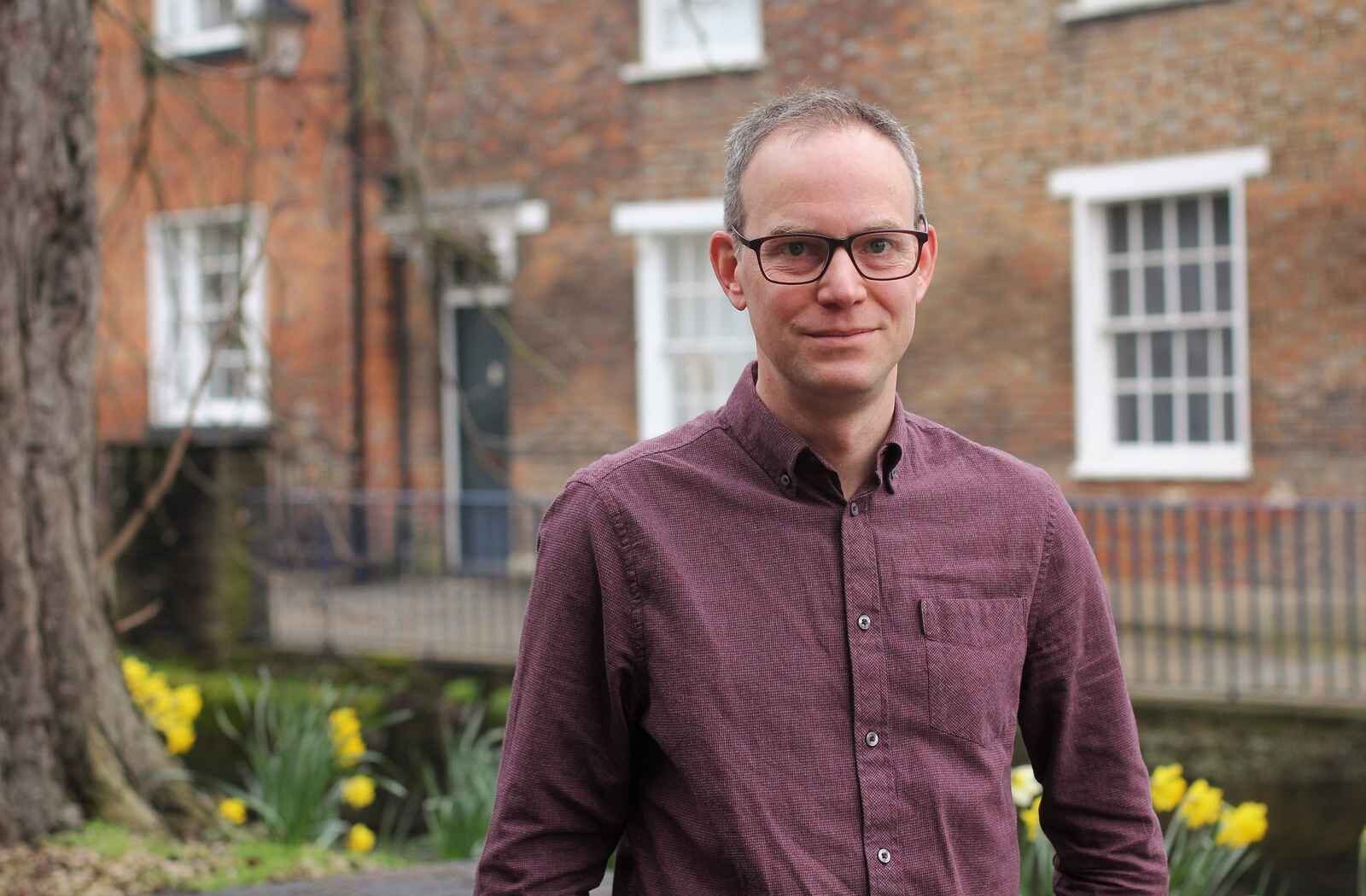
Dr William (Bill) Finnegan

Head of Programmes (Social Sciences)

Director of the Vice-Chancellor’s Colloquium

Departmental Lecturer in Environmental Studies

Bill is a human geographer and environmental social scientist specialising in environmental education.

At Oxford Lifelong Learning, he is part of the team that provides academic leadership for the social sciences domain. Bill also directs The Vice-Chancellor’s Colloquium, which he has led from the beginning of the programme in October 2023. Bill also oversees the applied research and project-based learning activities of the Oxford Living Lab for Environmental Sustainability.

Bill is the Sustainability Education and Research Manager in the Environmental Sustainability Team (Estates), where he leads work on the education and research workstreams of the Environmental Sustainability Strategy. Bill is also the academic programme lead of the Oxford Climate Forum.

Bill chairs the North American Association for Environmental Education (NAAEE) Research Symposium and served as guest editor of the Oxford Review of Education for a special issue on climate education. He contributes to the Global Environmental Education Partnership, the European Commission’s Education for Climate Coalition and the NAAEE eeRESEARCH and Guidelines for Excellence programmes.

Within Oxford Lifelong Learning, Bill’s primary teaching responsibility is the Vice-Chancellor’s Colloquium, an interdisciplinary skills programme for Oxford undergraduates with thematic cohorts on both climate change and artificial intelligence. Bill also leads a postgraduate module on environmental education at the School of Geography and the Environment, and teaches on postgraduate programmes at the Department of Education and a number of Oxford summer schools.

Bill researches environmental, sustainability and climate change education, and he developed the speculative digital storytelling methodology to explore climate futures with young people. Bill is a co-investigator of the following Oxford research and engagement projects: Education and Training for the Climate (ETC) research hub in the Department of Education, Nature Leadership for Human Flourishing project of the Department of Biology, and the Museum of Climate Hope initiative of the School of Geography and the Environment and Oxford’s Gardens, Libraries and Museums.

  • Robson, J., Puttick, S., & Finnegan, W. (2026). Rethinking education and training for the climate: individuals, systems, narrative skills and economic transformation. Oxford Review of Education, 52(2), 161–176. https://doi.org/10.1080/03054985.2025.2604227
  • Finnegan, W., Drayson, R., Guruprasad, S., & Runkle, Q. (2025). Empowering Young People to Teach their Teachers: Discovering Quality Climate Education Through Digital Storytelling (MECCE Project Funded Case Study). https://mecce.ca/publications/teach-the-teacher/
  • Talks, I., & Finnegan, W. (2025). Engaging the Next Generation: The state of environmental, sustainability and climate education in UK schools and effective practice in the classroom. National Association for Environmental Education. http://naee.org.uk/engaging-the-next-generation/
  • Finnegan, W., & d’Abreu, C. (2024). The hope wheel: A model to enable hope-based pedagogy in Climate Change Education. Frontiers in Psychology, 15. https://doi.org/10.3389/fpsyg.2024.1347392
  • Ettinger, J., McGivern, A., Spiegel, M. P., King, B., Shawoo, Z., Chapin, A., & Finnegan, W. (2023). Breaking the climate spiral of silence: Lessons from a COP26 climate conversations campaign. Climatic Change, 176(3), 22. https://doi.org/10.1007/s10584-023-03493-5
  • Finnegan, W. (2023). Beyond whole-school approaches to sustainability: Social practices and practice architectures at secondary schools in England. Energy Research & Social Science, 102, 103186. https://doi.org/10.1016/j.erss.2023.103186
  • Finnegan, W. (2023). ‘It’s beautiful, living without fear that the world will end soon’ – digital storytelling, climate futures, and young people in the UK and Ireland. Children’s Geographies, 21(5), 898–913. https://doi.org/10.1080/14733285.2022.2153329
Back to top