
Short course
Enterprise AI Engineering (online)

Course status:
Closed

Location:
Online

Dates and time:
13/03/2027 - 08/05/202710:00 - 16:30

Study format:
Short intensive

Fees:
£2,895.00
Now in its tenth year (including previous course titles), the Enterprise AI Engineering course is primarily designed to help participants with a background in software development to transition their career to Artificial Intelligence. Over the last decade, AI has transformed rapidly – and with it – so has the course.
The goal is helping participants figure out which direction they want to specialize in considering a ‘T shaped skills’ approach for AI Engineering’ i.e. you specialise in one area for AI Engineering (depending on our existing background) but are also technically proficient in other parts of the AI Engineering skillset.
This approach helps you to transition your career towards AI Engineering.
Apply for this course
You can sign up for course news for updates on future courses.
Contact the team
Phone: +44 (0)1865 286942
Email: technology@conted.ox.ac.uk
Learning outcomes
By completing the course, learners should be able to take an AI opportunity through the complete engineering lifecycle. They should be capable not simply of using AI models, but of engineering complete AI systems.
By the end of the course, participants will be able to:
● Understand the foundations and capabilities of modern AI systems and make informed model choices.
● Select, adapt and optimise AI applications
● Design the intelligence layer that transforms foundation models into useful AI systems and agents.
● Build reliable production software around AI models and agents.
● Design and operate the infrastructure required to run AI reliably at scale.
● Build AI systems that can be evaluated, observed, secured and governed.
● Translate AI capabilities into products, workflows and organisational outcomes that create measurable value.
Level and demands
This course is designed for professionals who want to build and deploy production-grade AI systems in enterprise environments. We expect that you would be familiar with software development – either as part of your current work or at some point in the past in your career.
Primary Audience
● Software Engineers
● AI Engineers
● Machine Learning Engineers
● Platform Engineers
● Cloud Engineers
● Full-Stack Developers
● Technical Product Managers
● AI Product Managers
● Solution Architects
● Forward Deployed Engineers
● Data Scientists transitioning into AI Engineering
Secondary Audience
● Technical founders
● Enterprise architects
● AI consultants
● Innovation teams
● Digital transformation leaders
● Engineering managers
● CTOs and technical executives
Entry requirements
Participants should have:
● Programming experience – either current or at some point in the past (preferably Python or TypeScript)
● Overall familiarity with software engineering principles
● Basic understanding of APIs and cloud services
● Introductory knowledge of AI and machine learning concepts
Note that AI assistance i.e. the use of AI tools for coding is encouraged in this course.
Programme details
AI Engineering – Definition and Components
Enterprise AI Engineering is the discipline of designing, building, deploying, governing and continuously improving AI systems that create measurable business value for Enterprises. It combines Platform Engineering, AI Product Engineering, AI Product Management and Forward Deployed Engineering.
Unlike traditional software engineering, AI Engineering must deal with uncertainty, probabilistic systems, evolving models, continuous evaluation and governance. This requires expertise spanning three complementary disciplines i.e.
● Platform Engineering
● AI Product Engineering and AI Product Management
● Forward Deployed Engineering
AI Engineering also encompasses:
● AI Assisted Development
● AI Agents and Agentic Workflows
● AI Governance
● Open Weight Models
● Small language models
● Harness engineering
We combine these abilities to build Generative AI systems – end to end.
Thus, the course covers the following themes:
1. Platform Engineering: How to design and manage the compute, infrastructure, data, deployment and operational platforms needed to run AI models, applications and agents securely, reliably and cost-effectively at scale.
2. AI Product Engineering: Design and build production AI applications, assistants, agents and workflows by combining models, prompts, context, retrieval, tools, APIs and software engineering.
3. AI Product Management: Identify valuable AI opportunities and translate them into product strategies, requirements, evaluation criteria and measurable customer and business outcomes.
4. Forward Deployed Engineering: Translate complex organisational problems into deployable AI solutions by combining customer discovery, requirements engineering, solution architecture, rapid prototyping, enterprise integration and change management.
5. AI-Assisted Development: Use AI coding assistants and agents across the entire software lifecycle,
6. AI Agents and Agentic Workflows: Design agents that reason, plan, use tools, access knowledge and take actions, and orchestrate them within reliable workflows involving software, other agents and humans.
7. AI Governance and Sovereign AI: Embed evaluation, security, safety, privacy, risk management, human oversight, compliance and accountability throughout the lifecycle of AI models, applications and agents.
8. Open-Weight Models: Select, customise, fine-tune, optimise and deploy open-weight models, and understand their growing importance for cost, privacy, control, enterprise AI and Sovereign AI.
9. Small Language Models: Understand the use of smaller and specialised language models can deliver efficient, low-cost and low-latency AI for domain-specific, edge, on-device and privacy-sensitive applications.
10. Building Generative AI Systems End-to-End: Bring the course together by designing, building, evaluating, governing, deploying and monitoring a production Generative AI system from requirements and architecture through to real-world operation and continuous improvement.
The course covers the following modules:
- Foundations of AI Engineering: Understand AI Engineering as the discipline of building reliable intelligent systems using foundation models, multimodal AI, agents and AI-native software.
- The Four Pillars of AI Engineering: Explore how Platform Engineering, AI Product Engineering, AI Product Management and Forward Deployed Engineering combine to take AI from infrastructure and ideas to deployed business solutions.
- AI-Assisted Software Development: Learn how coding agents, AI-native IDEs, vibe coding and specification-driven development are transforming requirements, architecture, coding, testing and documentation.
- The AI Engineering Workflow: Understand the end-to-end lifecycle and how AI assists each stage.
- Modern AI Architectures: Design systems that combine foundation models with retrieval, tools, memory, structured outputs, multimodality and orchestration.
- Prompt and Context Engineering: Learn how prompts, tools, retrieved knowledge, memory and contextual information are engineered to produce reliable model behaviour.
- AI Application Patterns: Explore reusable patterns for assistants, intelligent search, research systems, coding assistants, workflow automation and decision support.
- Foundations of AI Agents: Understand how agents use reasoning, planning, tools, memory and decision-making to pursue goals and take actions.
- Agentic Workflows: Design workflows that combine deterministic software, AI agents, multi-agent collaboration and human oversight.
- Enterprise Agent Engineering: Engineer the architecture, security, permissions, evaluation, deployment, monitoring, governance and AgentOps required for enterprise agents.
- Loop engineering, Harness engineering: Harness engineering is the engineering of the system around an AI model or agent that makes its behaviour reliable, repeatable, controllable, and production-ready. To put this in context: Model engineering improves the intelligence; Prompt/context engineering improves what the intelligence sees; Agent engineering gives the intelligence goals and actions; Harness engineering controls how that intelligence operates.
- Open-Weight Models: Understand how open-weight models enable greater control over model selection, customisation, fine-tuning, privacy, cost and deployment.
- Building with Open Models: Learn to evaluate, adapt, optimise and deploy open models using techniques such as fine-tuning, distillation, quantisation and local inference.
- AI Platform Engineering: Design reusable infrastructure for compute, model serving, data, APIs, identity, security, observability and scalable AI deployment.
- AI Operations: Apply MLOps, LLMOps and AgentOps to deploy, monitor and continuously improve production AI systems.
- AI Evaluation: Design continuous evaluation systems using benchmarks, automated evals, LLM-as-a-Judge, human evaluation, agent evaluation and business metrics.
- AI Governance: Embed risk management, security, compliance, responsible AI, model governance and agent governance throughout the AI engineering lifecycle including practices like sandboxing and guardrailing for models.
- Sovereign AI: Understand how organisations and nations maintain strategic control over their data, models, compute and AI operations while managing external dependencies.
- Building Production AI Systems: Apply software engineering principles including APIs, distributed systems, state management, authentication, security, reliability and scalability to production AI.
- AI User Experience: Design trustworthy human-AI interactions around transparency, uncertainty, feedback, personalisation, collaboration and human intervention.
- The Future of AI Engineering: Explore AI-native software, autonomous agents, open-weight ecosystems, Sovereign AI, Scientific AI, robotics and Physical AI as AI Engineering evolves toward intelligent systems that perceive, reason, decide and act.
Teaching methods
Development tracks
The course comprises of the following development tracks (note these are subject to change)
● Python: Using Python to create Machine learning and Deep Learning applications
● The Langchain ecosystem: To create end to end Generative AI projects including LangGraph, LangFlow, LangSmith including RAG, Agents etc
● Cloud implementation of AI Engineering processes using the GCP, AWS and Azure platforms
● LLM track: Using OpenAI Codex for RAG, Agents, AI assisted development etc
Note that you will get two months beyond the lectures to complete the development/capstone assignments.
IT requirements
This course is delivered online using Microsoft Teams. You will be required to follow and implement the instructions we send you to fully access Microsoft Teams on the University of Oxford’s secure IT network.
This course is delivered online; to participate you will need regular access to the Internet and a computer meeting our recommended Minimum computer specification.
It is advised to use headphones with working speakers and microphone.
Ajit Jaokar – Course Director
Ajit is a dedicated leader and teacher in Artificial Intelligence (AI), with a strong background in AI for Cyber-Physical Systems, research, entrepreneurship, and academia.
Currently, he serves as the Course Director for several AI programmes at the University of Oxford and is a Visiting Fellow in Engineering Sciences at the University of Oxford. His work is rooted in the interdisciplinary aspects of AI, such as AI integration with Digital Twins and Cybersecurity.
His courses have also been delivered at prestigious institutions, including the London School of Economics (LSE), Universidad Politécnica de Madrid (UPM), and as part of The Future Society at the Harvard Kennedy School of Government.
As an Advisory AI Engineer, Ajit specialises in developing innovative, early-stage AI prototypes for complex applications. His work focuses on leveraging interdisciplinary approaches to solve real-world challenges using AI technologies.
Ajit has shared his expertise on technology and AI with several high-profile platforms, including the World Economic Forum, Capitol Hill/White House, and the European Parliament.
Ajit is currently writing a book aimed at teaching AI through mathematical foundations at the high school level.
Ajit resides in London, UK, and he is actively engaged in advancing AI education and innovation both locally and globally. He is neurodiverse – being on the high functioning autism spectrum.
Ajit’s work in teaching, consulting, and entrepreneurship is grounded in methodologies and frameworks he developed through his AI teaching experience. These methodologies help to rapidly develop complex, interdisciplinary AI solutions in a relatively short time. These include:
1. The Jigsaw Methodology for low-code data science to non-developers.
2. The AI Product Manager framework and AI product market fit framework
3. Software engineering with the LLM stack
4. Agentic RAG for cyber-physical systems.
5. AI for Engineering sciences:
6. The ability of AI to reason using large language models
He also consults at senior advisory levels to companies.
His newsletter on AI in Linkedin has a wide following
https://www.linkedin.com/newsletters/artificial-intelligence-6793973274368856064/
Anjali Jain – Speaker
Co-founder, Erdos | Author | Senior Tutor in AI & ML, University of Oxford | AI Ambassador, Oxford AI & ML Competency Center | Data Architect, Metro Bank
Anjali Jain is a London-based data architect, author, and AI expert with over two decades of experience in software development, architecture, data strategy, and applied machine learning.
At the University of Oxford, she serves as Senior Tutor in AI and Machine Learning and as AI Ambassador at the AI & ML Competency Center, where she leads strategic initiatives in AI education and research.
She is the co-founder of Erdos Research, a collaborative research and innovation lab focused on building and implementing AI systems, advancing prompting methods, and developing tools for AI-assisted software engineering.
Anjali also serves as Data Architect at Metro Bank, where she supports the integration of AI into financial systems with a focus on data governance, data architecture and compliance.
She is the co-author of “10X AI Developer Guide with BRIDGE AI Framework” and “AI-Assisted Programming for Web and Machine Learning”, offering practical methodologies for building intelligent, human-centric technologies.
Ayşe Mutlu – Speaker
Data Scientist
Ayşe Mutlu is a data scientist working on Azure AI and devops technologies. Based in London, Ayşe’s work involves building and deploying Machine Learning and Deep Learning models using the Microsoft Azure framework (Azure DevOps and Azure Pipelines).
She enjoys coding in Python and contributing to Open Source Initiatives in Python.
Ajay Kumar Kambadkone Suresh – Speaker
Ajay Kumar serves as the Senior Director of AI Product Management for Agentforce, where he leverages extensive experience in scaling products and engineering solutions across multi-cloud environments for both startups and global enterprises. His deep expertise within the Salesforce ecosystem spans MuleSoft (the Salesforce platform), Marketing Cloud and Commerce Cloud.
Prior to joining Salesforce, Ajay was building Solutions at HackerRank and spent nearly a decade driving innovation at Microsoft.
A hands-on engineer and builder at heart, Ajay is also a keynote speaker on Global Stages and an active AI community leader.
He is deeply committed to the ecosystem, dedicating his time to mentoring and advising early- and mid-stage AI startups and builders.
He blogs frequently at AIClub.
Dr Amita Kapoor – Speaker
Associate Professor, Department of Electronics, SRCASW, University of Delhi
Amita Kapoor is an Associate Professor in the Department of Electronics, SRCASW, University of Delhi, and has been actively teaching neural networks and artificial intelligence for over twenty years, and she is an active member of ACM, AAAI, IEEE, and INNS.
Amita completed her masters in Electronics in 1996 and her Ph.D. in 2011.
During her Ph.D she was awarded a prestigious DAAD fellowship to pursue a part of her research work in Karlsruhe Institute of Technology, Karlsruhe, Germany. Amita was awarded the Best Presentation Award at the Photonics 2008 international conference.
Amita has more than 50 research publications in international journals and conferences, and has co-authored four books, including the best-selling “Deep learning with TensorFlow2 and Keras” with Packt Publications.
Passionate about using her skills for the betterment of society and humankind, Amita spends her spare time in various AI-related IoT and healthcare open source projects. She was recently awarded the Intel AI Spotlight Award 2019 for her work on the early detection of Acute Myeloid Leukemia using AI.
Amita’s present research areas include Machine Learning, Artificial Intelligence, IoT, Deep Reinforcement Learning, and Robotics.
Dr Andy McMahon – Speaker
Principal AI & MLOps Engineer, Barclays
Andrew (Andy) McMahon is a machine learning engineer and data leader with a passion for delivering valuable solutions that are robust, reliable and scalable.
As a Principal Engineer within the Chief Technology Office at Barclays, he is responsible for driving operational best practice for AI and ML products and solutions across the bank and runs the internal MLOps Community of Practice.
He has delivered high-value AI/ML solutions across multiple industries and is a multi-award winning data practitioner and leader.
He is also the author of the popular technical book, Machine Learning Engineering with Python, which is a practical guide to building real solutions using the latest ML engineering and MLOps best practices.
Arthur Orts – Speaker
Arthur Orts is Head of Generative and Agentic AI at Pictet Asset Management in Geneva, where he leads the development and adoption of AI capabilities across the firm.
Prior to joining Pictet, Arthur spent 10 years at Bloomberg in London, working in Financial Solutions with a focus on buy-side clients and portfolio management/risk analytics tools.
Arthur combines deep expertise in financial technology with hands-on experience building AI-powered workflows and agentic systems. He is particularly focused on the practical implementation of Agentic Artificial intelligence into professional environments, including coding assistants, autonomous agents and enterprise AI adoption strategies.
Barend Botha – Speaker
Barend Botha is a UK-based Product Manager working within the field of IoT, focused on building user focused data-driven products.
He is particularly interested in how artificial intelligence, combined with user experience, data analytics and visualisation can transform products that deliver real value to both businesses and consumers.
He draws on experience across product strategy, UX design, data analysis, software development and cross-functional delivery, working at the intersection of technology, design and applied AI.
Christoffer Noring – Speaker
Senior Cloud Advocate, Microsoft
Chris is Senior Cloud Advocate at Microsoft with more than 15 years’s experience in the IT industry. He’s a published author on several books about web development as well as the Go language. He’s also a recognized speaker as well as keynote speaker and holds a Google developer expert title.
Devrim Sonmez – Speaker
Devrim Sonmez serves as Senior Partner and Head of AI Division at Hepapi Software, a London-based Advanced AWS Partner specialising in Cloud solutions and Enterprise AI services for enterprises. At Hepapi, Devrim has led eight Generative AI projects across different enterprises in 2024 and 2025, covering diverse use cases from customer service automation and software development lifecycle optimisation to internal knowledge management systems, mostly in regulated industries such as Defence, Finance and Insurance.
Devrim is currently in his second year of a Master of Science in Data and Artificial Intelligence Ethics at The University of Edinburgh, which has deepened his understanding of ethical design, governance, and responsible deployment of AI and data-intensive technologies. Between 2017 and 2022, he was invited as a guest speaker as part of the course ‘Artificial Intelligence: Cloud and Edge Implementations’ (previously ‘Data Science for the Internet of Things’) at Oxford Lifelong Learning. He holds a Bachelor of Science in Mathematics and an MBA degree.
Devrim also serves as Technology Advisor at Bespokeist Partners VC, a private investment and Venture Capital, where he provides strategic guidance and late-stage investments to growing technology companies in Europe.
Jan Borovsky – Speaker
Jan Borovsky is a software developer with a background in design and computer science. This blend of creativity and technical expertise has shaped his approach to building applications from the ground up.
He contributed to the international mathematics project GeoGebra, leading innovative developments and collaborating with Southern Methodist University and the University of Wisconsin–Madison. His experience spans the entire project lifecycle, from concept to delivery, with a focus on creating impactful and user-friendly applications.
In 2025, Jan completed a program in ‘Generative AI, Cloud, and MLOps’ at Oxford Lifelong Learning, where he discovered his passion for applying AI to enhance software development. Since then, he has been integrating AI into his work and developing new applications, exploring how emerging technologies can be applied in practical and accessible ways.
Dr Kaouter Karboub – Speaker
Dr Kaouter KARBOUB is an assistant professor of computer science and artificial intelligence at the Moroccan Institute of Engineering Sciences. She received her PhD degree in Microelectronics and Computer Sciences: Internet of Things and Artificial Intelligence from Lorraine University-France.
She also holds an Engineering degree in Industrial Engineering and Logistic Operations from the High School of Electric and Mechanical Engineering in Morocco. She got High Honor degree for her dissertation “Contribution to improving medical care services using IoT and AI”.
She leads many non-profit associations to help women in the African world be involved in domains like AI for healthcare and education in cooperation with universities.
She is interested in intelligent systems that operate in large, nondeterministic, nonstationary or only partially known domains.
She believes that finding good solutions to these problems requires approaches that cut across many
different fields and, consequently, her research draws on areas such as artificial intelligence, decision theory, and operations research.
Dr Kaouter has been working with Ayse Mutlu and Fabrizio Romano to implement systems for test driven development for artificial intelligence in python.
Laurence Moroney – Speaker
Laurence Moroney leads AI Advocacy at Google, working with the Google AI Research and product development teams. He’s the best-selling author of ‘AI and Machine Learning for Coders,’ as well as the instructor on the Fundamentals of TinyML course at HarvardX, and the popular TensorFlow specializations with deeplearning.ai and Coursera.
He’s passionate about empowering software developers to succeed in Machine Learning, democratizing AI as a result. Laurence is based on Washington State in the USA.
Marina Fernandez – Speaker
Digital Hive and Innovation consultant, Anglo American Plc
Marina is an Analyst Developer and Software consultant at Anglo American plc working at the Digital Hive on innovative trading analytics and optimisation projects. She has over 18 years’ experience in Software Engineering, Business Analysis, Data Science and full software development life cycle in a variety of business domains including Commodity trading and optimisation, Finance, Machine Learning and Artificial Intelligence, e-commerce, e-learning, and web-development.
Marina holds an MSc, with distinction, in Software Engineering from the University of Oxford and a degree in Applied Mathematics from Lomonosov Moscow State University. In February 2020, Marina completed the course “Data science for internet of things” from the University of Oxford.
Mayank Sharma – Speaker
Mayank founded HiveMTD, a cloud-based ERP solution providing billing and VAT services to small and medium businesses in the UK under the Making Tax Digital campaign. He also co-founded HivePayroll, a cloud-based payroll solution launched in South Asia.
He has translated this experience in ERP to develop an end-to-end full stack platform using Vibe coding, specifically lovable and supabase. To this, also analytics was added using the same approach. He was the first ERP functional consultant to successfully implement SAP S/4HANA Central Finance with Central Payments and Central Taxation in 2018. Since 2020, he has co-authored three books on accounting and finance business processes using SAP ERP solutions.
Onur Bicakci – Speaker
Parth Shah – Speaker
Parth is an accomplished cloud-native solution architect with over 10 years of experience in architecting, developing, and deploying complex cloud-based solutions. He possesses a strong skill set spanning cloud architecture, full-stack development, AI/ML, and devops. Parth has a proven track record of success across diverse industries, including Mitron.TV, MTX Group Inc., Logictrix Infotech, OYO Rooms, and VowCarClinic. His expertise extends to leading cloud platforms like AWS and Google Cloud, with certifications validating his mastery in architecting robust and scalable solutions.
Parth’s experience includes pioneering advancements in AI-driven systems, such as an AI-powered crawler system and a state-of-the-art vaccine management portal. They have also demonstrated the ability to bridge theoretical concepts with practical applications, like crafting a platform capable of analyzing user videos to extract body measurements using deep learning algorithms. His commitment to staying at the forefront of technology, combined with a demonstrated history of driving impactful projects, positions him as a seasoned expert capable of steering complex initiatives towards success in the ever-evolving realm of cloud-native development.
List of cloud / AIcertificates:
AWS Certified Cloud Practitioner
AWS Certified Solutions Architect – Associate
AWS Certified Developer – Associate
AWS Certified Solutions Architect – Professional
AWS Certified SysOps Administrator – Associate
AWS Partner: Accreditation (Technical)
AWS Partner: Cloud Economics Accreditation
Google Cloud Professional Cloud Architect
Google Cloud Professional Cloud DevOps Engineer
Google Cloud Professional Data Engineer
Google Cloud Professional Cloud Security Engineer
Google Cloud Professional Machine Learning Engineer
Google Cloud Associate Cloud Engineer
Rosie Djurovic – Speaker
Rosie Djurovic is Head of AI at Brabners, a Top 100 law firm, where she leads AI strategy across the human, cultural and technical dimensions of AI transformation.
With a technical background spanning Ed-Tech, product development and consulting, Rosie brings a hands-on approach to AI adoption grounded in both practice and research.
She is an AI Researcher with Erdos Research, focusing on AI literacy and reskilling, and writes about human-AI augmentation at djuroai.com – exploring what it really means to build and work alongside intelligent systems.
Rosie is passionate about responsible AI and tech for good and is particularly interested in projects that use AI to solve real problems for communities and the environment.
Shaig Abduragimov – Speaker
Shaig Abduragimov leads OpenAI’s Solutions Engineering for Education in EMEA and APAC. In this capacity, he partners with governments, universities and national systems to architect and operationalise AI solutions powering education strategies and institutional transformation. Prior to OpenAI, Shaig worked at Palantir, driving mission-critical AI and data deployments at scale across the public and private sectors.
Vignesh Manikam – Speaker
Vignesh Manikam is the AI Risk Manager Lead at Nationwide Building Society, where he oversees AI validation and the strategic development of enterprise-wide governance frameworks. He leads the technical delivery of IBM Watson Governance, embedding ethical safeguards and model risk oversight into both customer-facing and operational systems. His work ensures that AI solutions adhere to rigorous standards of transparency, fairness and regulatory compliance, bridging innovation with institutional trust.
Prior to his role at Nationwide, Vignesh served as a Director at Barclays, where he led the technical delivery of Sarbanes-Oxley (SOX) compliance and successfully executed a range of regulatory programs (IFRS9, BCBS) across the bank’s global footprint. His leadership was pivotal in enhancing governance and control structures for emerging technologies and data-driven platforms.
Vignesh holds the Artificial Intelligence Governance Professional (AIGP) certification and the Certificate in Quantitative Finance (CQF).
Participants who satisfy the course requirements will receive a University of Oxford digital certificate of completion. To receive a certificate at the end of the course you will need to:
- Achieve a minimum attendance at online sessions of 75%.
- Answer all the learning quizzes provided (these are short quizzes designed to ensure you have understood the material in each unit)
- Participants are expected to actively participate and complete the exercises which will be given during the course. These exercises involve coding / hands-on exercises (individually and also in groups) in sprints relating to the AI topics covered in class.
The certificate will show your name, the course title and the dates of the course you attended. You will also be able to download your certificate or share it on social media if you choose to do so.
Dates, times and delivery
This course is delivered over 8 weeks, with two sessions delivered each week, on Tuesday evenings and Saturday mornings. There is a minimum attendance requirement of 75%.
Saturday sessions:
4 to 6 hours of virtual classroom learning on Saturdays (10am – 4.30pm UK time, including breaks)
- Saturday 13 March
- Saturday 20 March
- Saturday 3 April*
- Saturday 10 April
- Saturday 17 April
- Saturday 24 April
- Saturday 1 May
- Saturday 8 May
Tuesday sessions:
1 to 2 hours online each week on Tuesdays (7pm – 9pm UK time)
- Tuesday 16 March
- Tuedsay 23 March
- Tuesday 30 March
- Tuesday 6 April
- Tuesday 13 April
- Tuesday 20 April
- Tuesday 27 April
- Tuesday 4 May
A world clock, and time zone converter can be found here: https://bit.ly/3bSPu6D
*Please note there is no session on Saturday 27 March due to public holidays in the UK.
In addition, please note that Daylight Saving Time comes into effect on Sunday 29 March, and that for subsequent sessions UK Time will be running at UTC +1.
We recommend you allow around 10 – 12 hours study time per week in addition to the hours outlined above, and the course will culminate in a capstone project. Note that you will get two months beyond the lectures to complete the development/capstone assignments.
You will be fully supported by the core team of tutors who will be available during the week to answer questions.
Accessing Your Online Course
Details about accessing the private MS Teams course site will be emailed to you during the week prior to the course commencing.
Please get in touch if you have not received this information within three working days of the course start date.
Fees
| Description | Costs |
|---|---|
| Course fee (standard) | £2895.00 |
Recommended reading
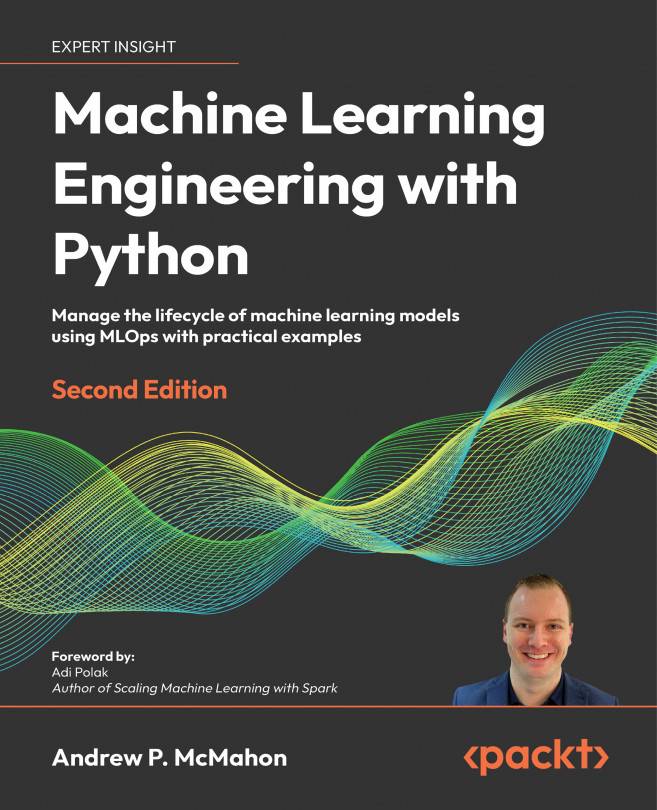 An e-copy of McMahon, Andrew P. (2023). Machine Learning Engineering with Python: Manage the lifecycle of machine learning models using MLOps with practical examples. 2nd ed. [ebook] Packt Publishing will be provided to you, and is included in the course fees.
Chris Noring’s book
Module code: O26C067H7Y
How to apply for this course
1. Please complete the application questionnaire no later than Thursday 4 March 2027 to give us a sense of your knowledge and experience.
Important: We do not expect you to have knowledge or experience in all of the areas on this questionnaire!
2. If, after the academic panel have reviewed your questionnaire, you are invited to apply for the course, we will contact you regarding payment of the course fee.
Payment
Note that we accept applicants on a rolling basis and expect this course to be oversubscribed.
Places will only be confirmed upon receipt of payment.
Fees include electronic copies of all course materials and tuition.
Course fees are VAT exempt.