

Short course
AI Engineering: Agents, Vibe Coding and Full-Stack AI (online)

Course status:
Course ended

Location:
Online

Dates:
31/01/2026 - 25/04/2026

Study format:
Short intensive

Fees:
£4,135.00
Build next-generation AI applications
This course introduces the core skills of modern AI engineering. It is designed for developers and technical professionals who want to build intelligent systems using large language models (LLMs) and explore how AI is applied in practice.
You will explore how AI engineers work across full-stack systems, combining software development, machine learning, prompt engineering and agent orchestration. These elements come together to build semi-autonomous, agentic systems that can receive and carry out tasks.
Taught by industry experts, this AI engineering course combines the latest insights with hands-on tasks, giving you the opportunity to apply what you learn as you go. You will explore workflows such as vibe coding, where developers and AI write code together, and learn practical techniques for guiding the behaviour of AI systems.
You will also learn how to work with LLMs, APIs, data and user input to create intelligent behaviours that can be applied across a range of AI applications. To implement what you’ve learned, you will then complete a final project where you design and prototype an AI-driven system.
This course is designed for developers, engineers and technical professionals who want to expand their skills or move into AI-related roles such as AI engineer and data scientist roles. Some prior coding experience (in any programming language) is expected. If you are unsure about your background, we are happy to advise. In some tasks, AI may be used to assist with coding.
Apply for this course
The next course dates are not yet confirmed. Add your name to the waiting list for a priority update on this course. You can sign up for course news for updates on future courses.
Programme details
The course covers the following topics:
● Foundation models and LLMs: fine-tuning, embedding, RAG, OpenAI function calling, LangGraph orchestration
● Prompt and agent engineering: building multi-step agents, tools, tool-use reasoning, prompt scaffolding, planning
● AI-Native Interfaces: Copilot-style UX, custom GPTs, autonomous agents in apps, voice/UI APIs
● AI assisted development: vibe code, spec driven development (lovable)
● Full-stack GenAI Systems: combining frontend (e.g., Vercel, Streamlit), backend (Supabase), and LLM backends
● AI agents – stacks, components, agentic frameworks (e.g., LangGraph, CrewAI, LangChain, Llamaindex)
● AI systems: machine learning, deep learning
● MLOps and LLMOps
● AI product management
● Governance, observability and guardrails: governance and safety (fairness, guardrails, explainability, observability, compliance, causality, evaluation loops)
● Cloud-native AI: using Azure AI Foundry, AWS and open agents to deploy scalable LLM systems
● Platform usage: use of tools and platforms that manage governance and observability
● Introduction to AI research
● Capstone project
N.B. Further updates are likely to be made prior to the start of the course to reflect the fast-changing nature of the subject area.
IT requirements
This course is delivered online using Microsoft Teams. You will be required to follow and implement the instructions we send you to fully access Microsoft Teams on the University of Oxford’s secure IT network.
This course is delivered online; to participate you will need regular access to the Internet and a computer meeting our recommended Minimum computer specification.
It is advised to use headphones with working speakers and microphone.
Ajit Jaokar – Course Director
Visiting Fellow, Department of Engineering Science, University of Oxford
Anjali Jain
Digital Solutions Architect, Metrobank
Ayşe Mutlu
Data Scientist
Mayank Sharma
Founder, HiveMTD
Dr Amita Kapoor
Associate Professor, Department of Electronics, SRCASW, University of Delhi
Marina Fernandez
Digital Hive and Innovation consultant, Anglo American Plc
David Knott
Chief Technology Officer, UK Government
Dr Andy McMahon
Principal AI & MLOps Engineer, Barclays
John Alexander
LLM Strategy Consultant and AI Developer
Christoffer Noring
Senior Cloud Advocate, Microsoft
Dr Martin-Immanuel Bittner
Chief Executive Officer, Redouble AI
Dr Kaouter Karboub
Assistant Professor of Computer Science and Artificial Intelligence, Moroccan Institute of Engineering Sciences
Aleksander Molak
Machine Learning Researcher, Educator, Consultant and Author
Parth Shah
Cloud-native solution architect
Kajal Singh
Senior Data Scientist
Magnús Smárason
AI researcher and digital innovator
Shaig Abduragimov
OpenAI
Isaak Fabien Sundeman
Growth Market Specialist, Lovable
Jan Borovsky
Software Developer
Steven Kok
Member of Boston Consulting Group’s Digital, Financial Institutions and Energy practices
Vignesh Manikam
AI Risk Manager Lead, Nationwide Building Society
Vikkas Arun Pareek
Senior IT and AI Consultant
David A Raho
PhD researcher in Law and Criminology at Sheffield Hallam University
Devrim Sonmez
Senior Partner and Head of AI Division at Hepapi Software
Mahesh Yadav
AI product management expert
Barend Botha
Data visualisation consultant
Ajay Kumar Kambadkone Suresh
Senior Director of AI Product Management, Agentforce
Richard Naszcyniec
Technology executive and futurist
Arthur Orts
Head of Generative and Agentic AI, Pictet Asset Management
Dimitris Perdikou
Government Chief Engineer, Department for Science, Innovation and Technology
Participants who satisfy the course requirements will receive a University of Oxford digital certificate of completion. To receive a certificate at the end of the course you will need to:
- Achieve a minimum attendance at online sessions of 75%.
- Answer all the learning quizzes provided (these are short quizzes designed to ensure you have understood the material in each unit)
- Participants are expected to actively participate and complete the exercises which will be given during the course. These exercises involve coding / hands-on exercises (individually and also in groups) in sprints relating to the AI topics covered in class.
The certificate will show your name, the course title and the dates of the course you attended. You will also be able to download your certificate or share it on social media if you choose to do so.
Dates, times and delivery
This course is delivered over 12 weeks, with two sessions delivered each week, on Tuesday evenings and Saturday mornings. There is a minimum attendance requirement of 75%.
Saturday sessions:
4 to 6 hours of virtual classroom learning on Saturdays (10am – 4.30pm UK time, including breaks)
Tuesday sessions:
1 to 2 hours online each week on Tuesdays (7pm – 9pm UK time)
A world clock, and time zone converter can be found here: https://bit.ly/3bSPu6D
Please note there is no session on Saturday 4 April due to public holidays in the UK.
In addition, please note that Daylight Saving Time comes into effect on Sunday 29 March, and that for subsequent sessions UK Time will be running at UTC +1.
We recommend you allow around 10 – 12 hours study time per week in addition to the hours outlined above, and the course will culminate in a capstone project.
You will be fully supported by the core team of tutors who will be available during the week to answer questions.
Accessing Your Online Course
Details about accessing the private MS Teams course site will be emailed to you during the week prior to the course commencing.
Please get in touch if you have not received this information within three working days of the course start date.
Fees
| Description | Costs |
|---|---|
| Course fee (standard) | £4135.00 |
Recommended reading
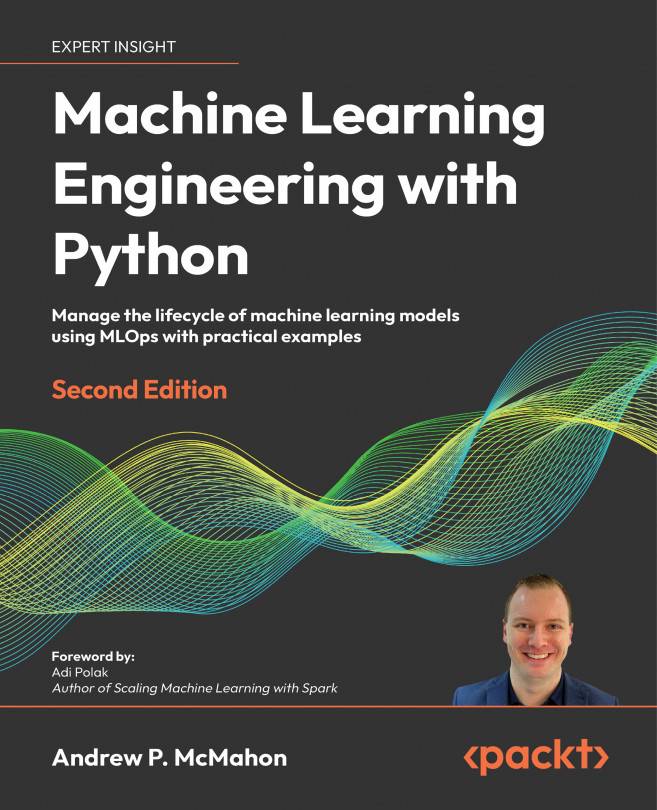 An e-copy of McMahon, Andrew P. (2023). Machine Learning Engineering with Python: Manage the lifecycle of machine learning models using MLOps with practical examples. 2nd ed. [ebook] Packt Publishing will be provided to you, and is included in the course fees.
Module code: O25C067H7Y
How to apply for this course
Applications are now closed.
Payment
Places will only be confirmed upon receipt of payment.
Fees include electronic copies of all course materials and tuition.
Course fees are VAT exempt.