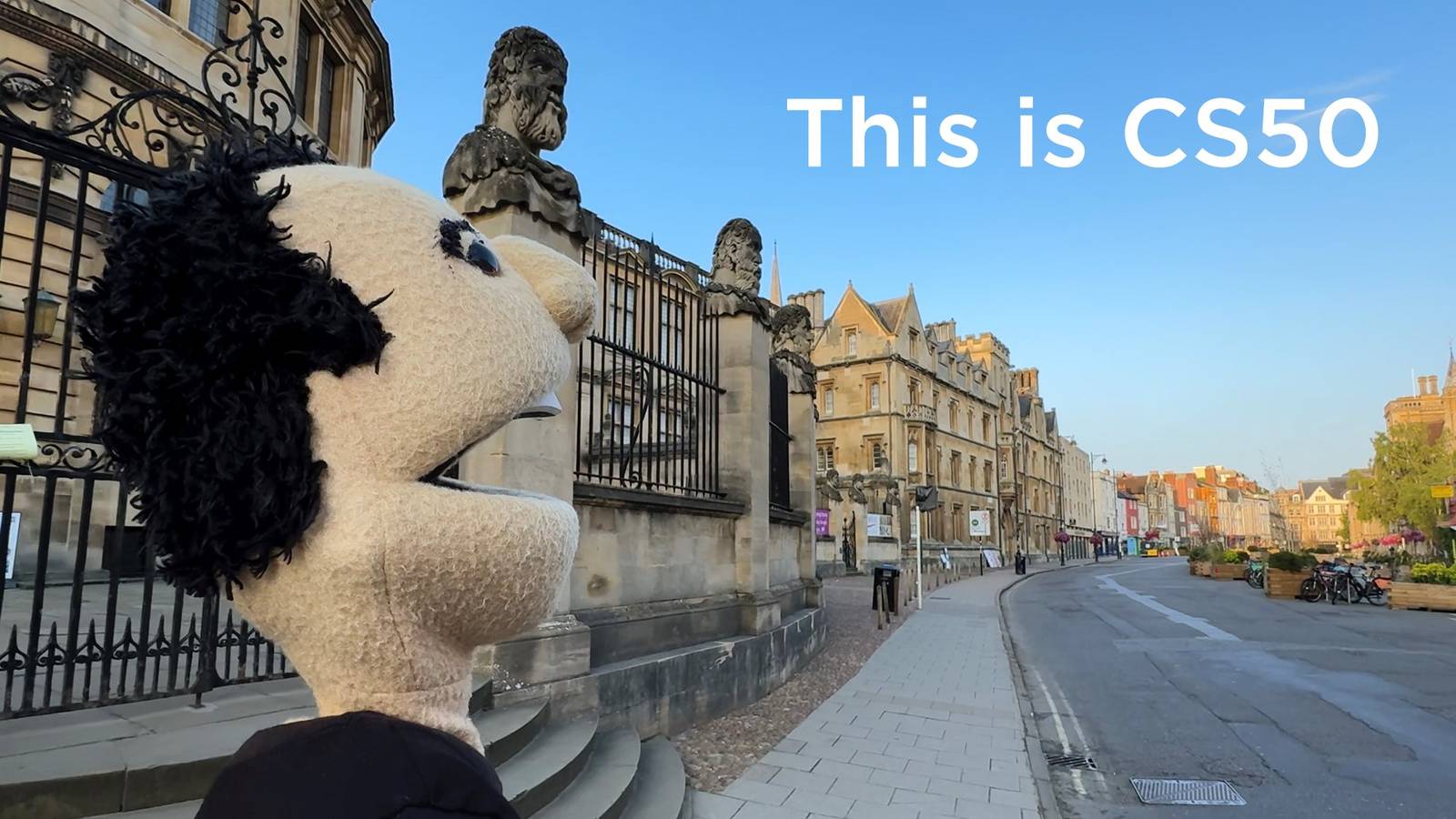
Based on Harvard's famed introductory course in computer science, CS50 is now available at Oxford. This course teaches you how to solve problems, both with and without code, with an emphasis on correctness, design, and style.
Filter by:
Filters
Start month
Day of the week
Time of day
Based on Harvard's famed introductory course in computer science, CS50 is now available at Oxford. This course teaches you how to solve problems, both with and without code, with an emphasis on correctness, design, and style.

The course looks at what, if anything, it is that Jews, Christians and Muslims are agreeing about when they claim that there is a God; and we shall look at what, if any, prospects there are for rationally defending or attacking this claim.

This course builds on Part 1, and allows you to extend and revise your grammatical knowledge so far while reading some engaging texts in Greek.

Feminism is a political movement aiming to end the oppression of women. But what is to be a 'woman'? Do women have distinctive ways of knowing and acting? What is gender injustice? The course engages with such core issues of feminist thought.

This course will teach you the basics of quantum physics. From the quantisation of energy, we will explore the idea of a wavefunction, learn about entanglement, the uncertainty principle and how they are used for teleportation and quantum computers.

Explore the global energy transition, from renewable energy and energy security to climate change and Net Zero. Examine the technologies, policies and challenges shaping the future of sustainable, reliable and accessible energy.

Linear algebra and its matrices appear throughout the sciences and in the mathematical parts of the social sciences. This basic course is a prerequisite to understanding advanced mathematics and myriad closely and distantly related quantitative fields.

From the American Civil War to WWII, explore how railways moved armies, supplies, civilians and the wounded, shaped strategy, resisted air attack, and became essential to both battlefield success and the home front everywhere.

We think we know, but do we? We think we are free, but are we? We think our actions are moral, but are they? What is this reality we take ourselves to live in? The oldest questions meet the newest technology in this online introduction to philosophy.
Refine your fluency and express yourself naturally, precisely, and with confidence

Whether you're looking to improve your fluency, master different registers, or expand your lexical repertoire and grammar structures, this course will help you to converse spontaneously and effectively in both every day and professional context.

This course introduces you to the basic principles of Classical Latin. It provides a firm basis of grammar, sentence structure and vocabulary of the language, through which you will be able to read and translate into English Roman drama in adaptation.