
Short course
Greening Up: Why and How to Re-Green Towns and Cities

Course status:
Closed to new applications


Dates and time:
08/10/2025 - 08/10/202509:30 - 17:00

Study format:
Short intensive

Fees:
£160.00 – £330.00
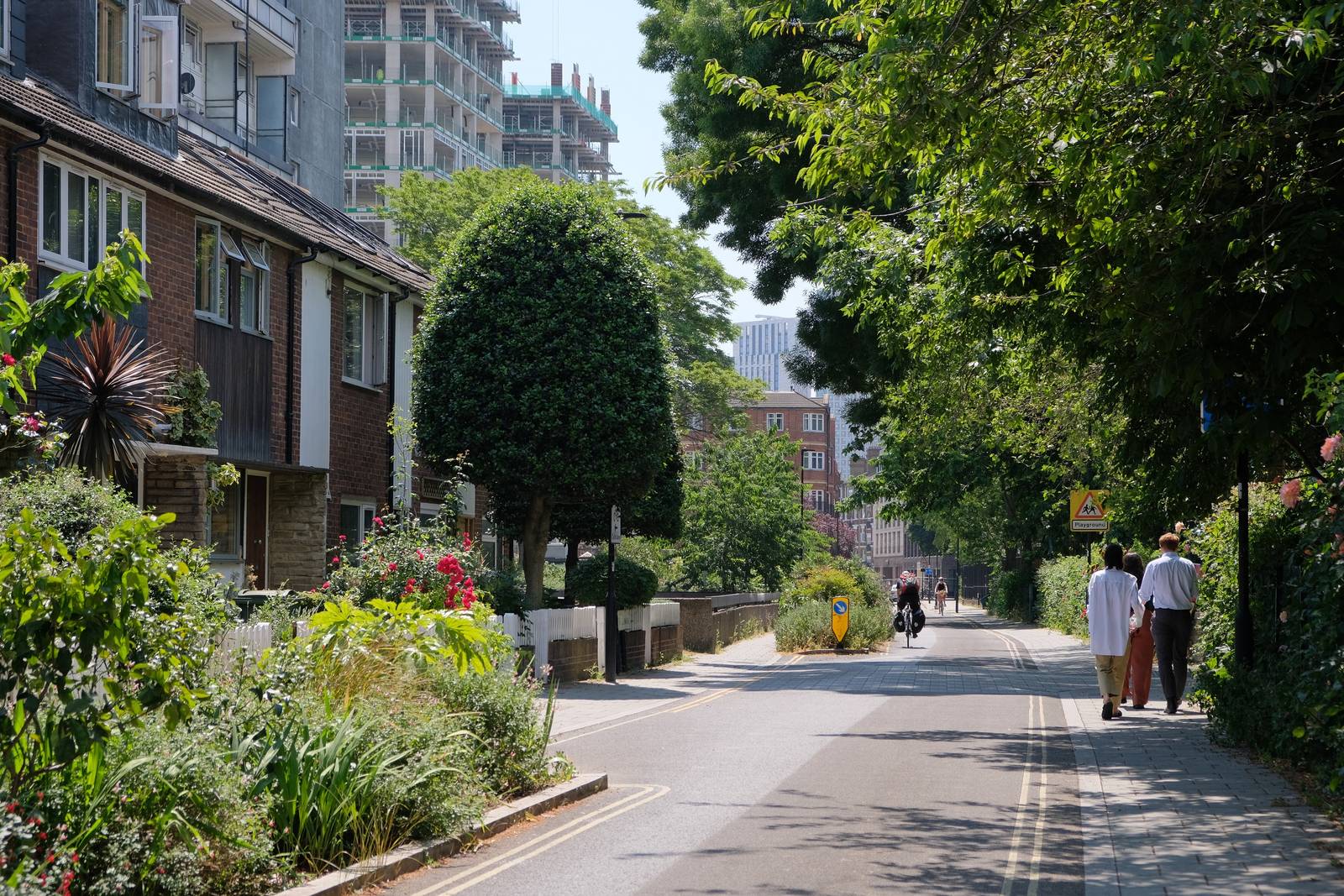
Nearly everyone agrees, in principle, that urban greenery is a good thing. Within four months of being elected the Labour government had set up a new Tree Planting Task Force affirming that 'Trees deliver huge social, environmental and economic benefits – from absorbing carbon dioxide, cooling our cities, improving wellbeing and helping reduce NHS costs', arguing that there has never been 'a more crucial time to take action to increase and improve the number of trees across the UK'. In 2020, the previous Conservative government introduced a planning requirement for street trees on every new street and argued that 'trees improve the quality of lives and are vital to our ambition to reach net zero by 2050'.
However, urban greening still faces many challenges.
- Levels of urban greenery are declining. Between 2001 and 2018, urban green spaces in England declined from 63% of the urban area to 55%.
- New places are less green than old places. Recently created neighbourhoods have up to 40% less greenery than late nineteenth and early twentieth century neighbourhoods.
- Many councils cut down old trees and fail to plant new ones.
- Access to greenery is not equal in our communities. New analysis conducted for the Create Streets Greening Up report finds that the ten most prosperous places in the UK have 25% tree canopy cover. The ten least prosperous have 15%.
During this course, you will hear the latest research and evidence on the contribution greenery makes to the urban environment: the benefits for people, for the places we live in and for the planet.
You will learn what the key blockers are to unleashing an urban greening revolution in communities across our towns and cities, and will gain practical advice about how to overcome some of these. The course is particularly useful for local councillors, BID managers and members of the community looking to bring nature into their towns and places
On the day before this course (07 October), there is a course on Nature in the historic built environment: how to make the most of it. If you book onto this course you will be eligible for a 15% discount on the other. Please email cwhe@conted.ox.ac.uk for further details, and please email res-ctr@conted.ox.ac.uk to find out about accommodation.
Apply for this course
Apply using the button below.
9.30am- Introductions
9.45am- Session 1: What makes great places? And how important really is greenery for our towns and cities?
10.45am- Break
11.00am- Session 2: What is preventing an unleashing of greening across our towns and cities?
11.45am- Session 3: What can we learn from different places in the UK and France? And what greening options are available?
12.30am- Online course ends. Lunch for in-person attendees
1.15pm- Site walkaround of 2 areas in Oxford (1 with lots of greenery, 1 with none)
3.00pm- Short break
3.15pm- Session 4: Practical workshop: Design a greening up strategy.
4.00pm- Discussion and wrap up
4.45pm- Close
Digital Certification
Digital badge
Upon successful completion of this course, you will be issued with an official digital badge. After the course, you will receive an email with a link and instructions on how to download your digital badge. You will be able to add your badge to your email signature and share it on social media if you choose to do so.
Teaching methods
There will be an in-depth session looking at case studies from across the UK and France (“the good, the brave and the ugly”). After lunch, for those attending in person, a site walkaround visiting two sites (one green, one “grey”) will be followed by a practical workshop where attendees will start working on an urban greening strategy and design of their own, putting their new-found knowledge into practice.
This course is delivered in partnership with Create Streets. Their Greening Up report has been called ‘timely and inspiring … transform[ing] our urban spaces into greener, healthier places’.

Fees
| Description | Costs |
|---|---|
| In-person tuition | £330.00 |
| Online tuition: Half day only | £160.00 |
| Hot Lunch | £21.25 |
Module code: O25P296PAR