
Short course
Medieval Chivalry

Course status:
Applications being accepted

Location:
Online

Dates:
13/04/2027 - 22/06/2027

Study format:
Online - live

Fees:
£430.00
Commonly perceived as an ethical code of the aristocratic elite, chivalry had wide-ranging impacts on people at all levels of medieval society as a pervasive element of medieval culture, a moral compass, and even as a military strategy. In this course, we will explore the evolution of chivalry, from its twelfth-century origins, through to its thirteenth-century heyday and then to its fifteenth-century decline.
The course is arranged around key themes that explore the relationship between medieval social, political and religious life. Using case studies of the Crusades, The Hundred Years War and the Wars of the Roses, we will consider chivalry’s influence on the Church, monarchy and state, and discover how courtly love shaped relationships between men and women.
This course will also explore the “afterlives” of medieval chivalry, by considering how later cultures have rediscovered and appropriated chivalry for political and cultural ends, such as rediscovery of medieval art and culture in the gothic revival and pre-Raphaelite art of the nineteenth century, and the disturbing appropriation of chivalric symbols in twentieth-century fascist propaganda.
Book this course
Book your place online using the button below.
Programme details
This course begins on the 13 Apr 2027, which is when course materials are made available to students. Students should study these materials in advance of the first live meeting, which will be held on Tue 20 Apr 2027, 18:00-19:00 (UK time).
- The origins of chivalry
- Chivalry and kingship
- Chivalry and the state
- Chivalry and the Church
- Chivalry and the Crusades
- Chivalry and the Hundred Years War
- Chivalry and the arts
- Chivalry and gender
- After the Middle Ages: Chivalry and the Victorians
- After the Middle Ages: Chivalry in the Twentieth Century
Level and demands
This course is open to all and no prior knowledge is required.
This course is offered at FHEQ Level 4 (first year undergraduate level), and you will be expected to engage in independent study in preparation for your assignments and for the weekly webinar. This may take the form of reading and analysing set texts, responding to questions or tasks, or preparing work to present in class.
English Language Requirements
We do not insist that applicants hold an English language certification, but we warn that they may be at a disadvantage if their language skills are not of a comparable level to those qualifications listed on our website. If you are confident in your proficiency, please feel free to enrol. For more information regarding English language requirements, please see here.
Course aims
This course aims to:
- Explore the chronological development medieval chivalry between the 12th and 15th centuries, and its afterlives up to the present day
- Explore the gap between the romantic ideal of chivalry and the live medieval reality
- Provide a contextual understanding of medieval chivalry through a multidisciplinary critical analysis of historical texts, art, literature and music
IT requirements
Any standard web browser can be used to access course materials on our virtual learning environment, but we recommend Google Chrome. We also recommend that students join the live webinars on Microsoft Teams using a laptop or desktop computer rather than a phone or tablet due to the limited functionality of the app on these devices. Students will need a reliable internet connection and a computer that meets our recommended minimum computer specification.
Programme details
This course begins on the 13 Apr 2027, which is when course materials are made available to students. Students should study these materials in advance of the first live meeting, which will be held on Tue 20 Apr 2027, 18:00-19:00 (UK time).
- The origins of chivalry
- Chivalry and kingship
- Chivalry and the state
- Chivalry and the Church
- Chivalry and the Crusades
- Chivalry and the Hundred Years War
- Chivalry and the arts
- Chivalry and gender
- After the Middle Ages: Chivalry and the Victorians
- After the Middle Ages: Chivalry in the Twentieth Century
Teaching methods
This course takes place over 10 weeks, with a weekly learning schedule and weekly live webinar held on Microsoft Teams. Shortly before a course commences, students are provided with access to an online virtual learning environment, which houses the course content, including video lectures, complemented by readings or other study materials. Any standard web browser can be used to access these materials, but we recommend Google Chrome. Working through these materials over the course of the week will prepare students for a weekly 1-hour live webinar you will share with your expert tutor and fellow students. All courses are structured to amount to 100 study hours, so that on average, you should set aside 10 hours a week for study. Although the course finishes after 10 weeks, all learning materials remain available to all students for 12 months after the course has finished.
All courses are led by an expert tutor. Tutors guide students through the course materials as part of the live interactions during the weekly webinars. Tutors will also provide individualised feedback on your assignments. All online courses are taught in small student cohorts so that you and your peers will form a mutually supportive and vibrant learning community for the duration of the course. You will learn from your fellow students as well as from your tutor, and they will learn from you.
Learning outcomes
By the end of the course students will be expected to:
- Identify and analyse political, religious, cultural and social changes in medieval Europe approx. 1100-1500, and understand their cultural impact on later societies.
- Demonstrate the ability to analyse diverse primary and secondary sources, including online resources and visual materials.
- Be able to communicate the results of independent study accurately and reliably, using structured and coherent arguments, having demonstrated this through in-class interactions and written assignments
Assessment methods
You will be set two pieces of work for the course. The first 500 words are due halfway through your course. This does not count towards your final outcome but preparing for it, and the feedback you are given, will help you prepare for your assessed piece of work of 1,500 words due at the end of the course. The assessed work is marked pass or fail.
Dr Rachel Moss
Dr Rachel E. Moss is a senior lecturer in history at the University of Oxford and the University of Northampton. Prior to this she was a Leverhulme Early Career Fellow in the Faculty of History at the University of Oxford. Her ‘superbly thought-through’ (Arthuriana) first book, Fatherhood and its Representations in Middle English Texts, was published by D.S. Brewer in September 2013. A specialist in late medieval English history and literature, she has researched and written on family, gender, sexuality, gentry and mercantile societies, and literary culture. Passionately invested in making the past accessible to all and in making the academy a more inclusive place, Rachel regularly writes for mainstream publications such as History Today and The Times Higher Education on themes including education, academic culture and late medieval history.
Assessment methods
You will be set two pieces of work for the course. The first 500 words are due halfway through your course. This does not count towards your final outcome but preparing for it, and the feedback you are given, will help you prepare for your assessed piece of work of 1,500 words due at the end of the course. The assessed work is marked pass or fail.
Level and demands
This course is open to all and no prior knowledge is required.
This course is offered at FHEQ Level 4 (first year undergraduate level), and you will be expected to engage in independent study in preparation for your assignments and for the weekly webinar. This may take the form of reading and analysing set texts, responding to questions or tasks, or preparing work to present in class.
English Language Requirements
We do not insist that applicants hold an English language certification, but we warn that they may be at a disadvantage if their language skills are not of a comparable level to those qualifications listed on our website. If you are confident in your proficiency, please feel free to enrol. For more information regarding English language requirements, please see here.
Fees
| Description | Costs |
|---|---|
| Course Fee | £430.00 |
Module code: O26P743LHZ
Please use the ‘Book now’ button on this page. Alternatively, please complete an enrolment form.
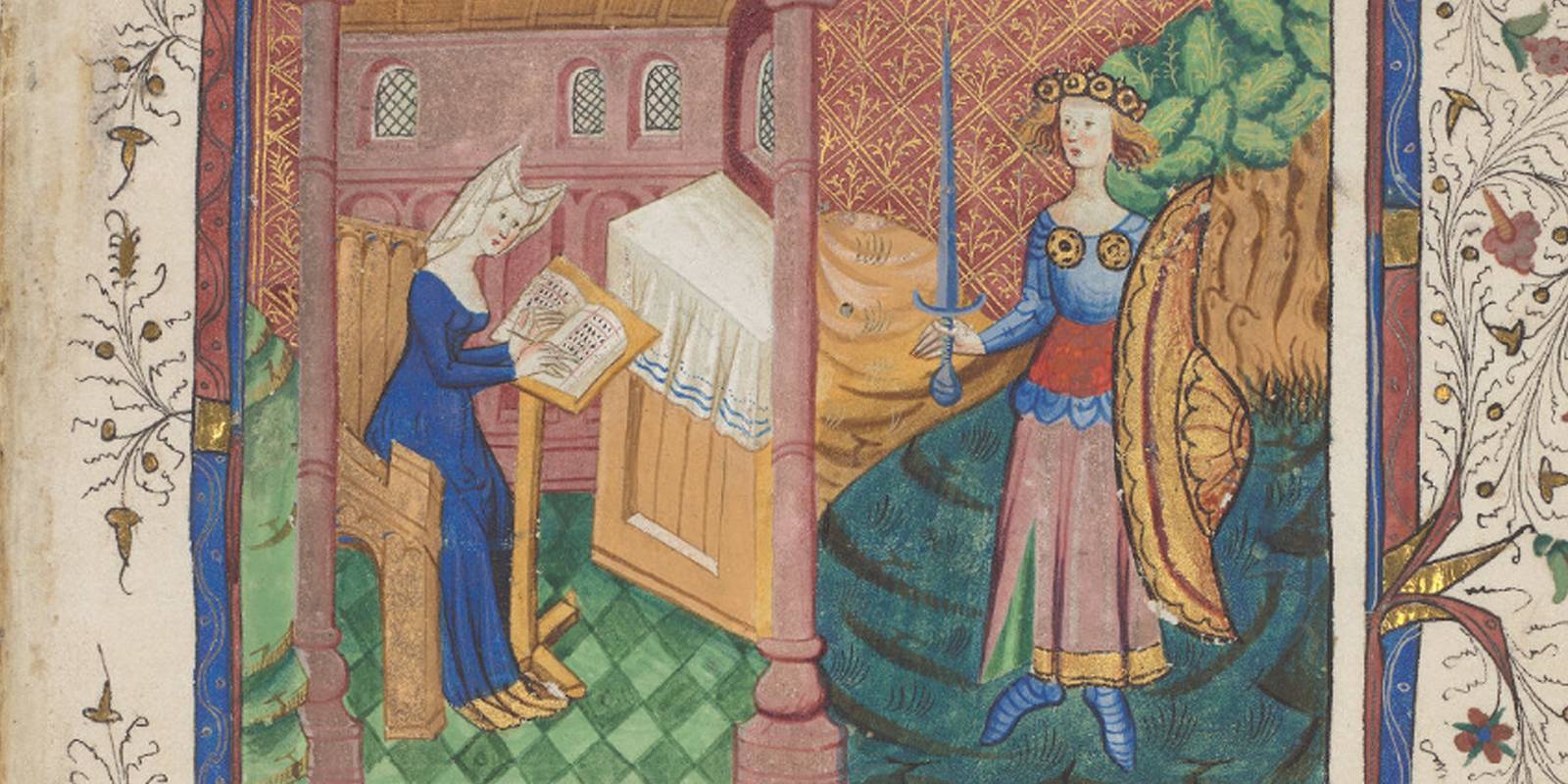
Course image is from the archive of the British Library (Christine de Pizan, Le livre des faits d’armes et de chevalerie, British Library Harley MS 4605)