
Award courses
Postgraduate Diploma in Wildlife Conservation


Turn your passion for wildlife conservation into the expertise to protect threatened species and habitats worldwide.
The Postgraduate Diploma in Wildlife Conservation (Recanati–Kaplan) is an eight-month, full-time, residential course designed for early-career wildlife researchers and conservation practitioners. Delivered by the Department of Biology’s Wildlife Conservation Research Unit (WildCRU), the course equips students with cutting-edge techniques for monitoring and managing wildlife and their habitats, with a particular focus on terrestrial mammals and conservation challenges in the developing world.
KEY INFORMATION
Upcoming application deadline: Wednesday 27 January 2027, 12.00 GMT

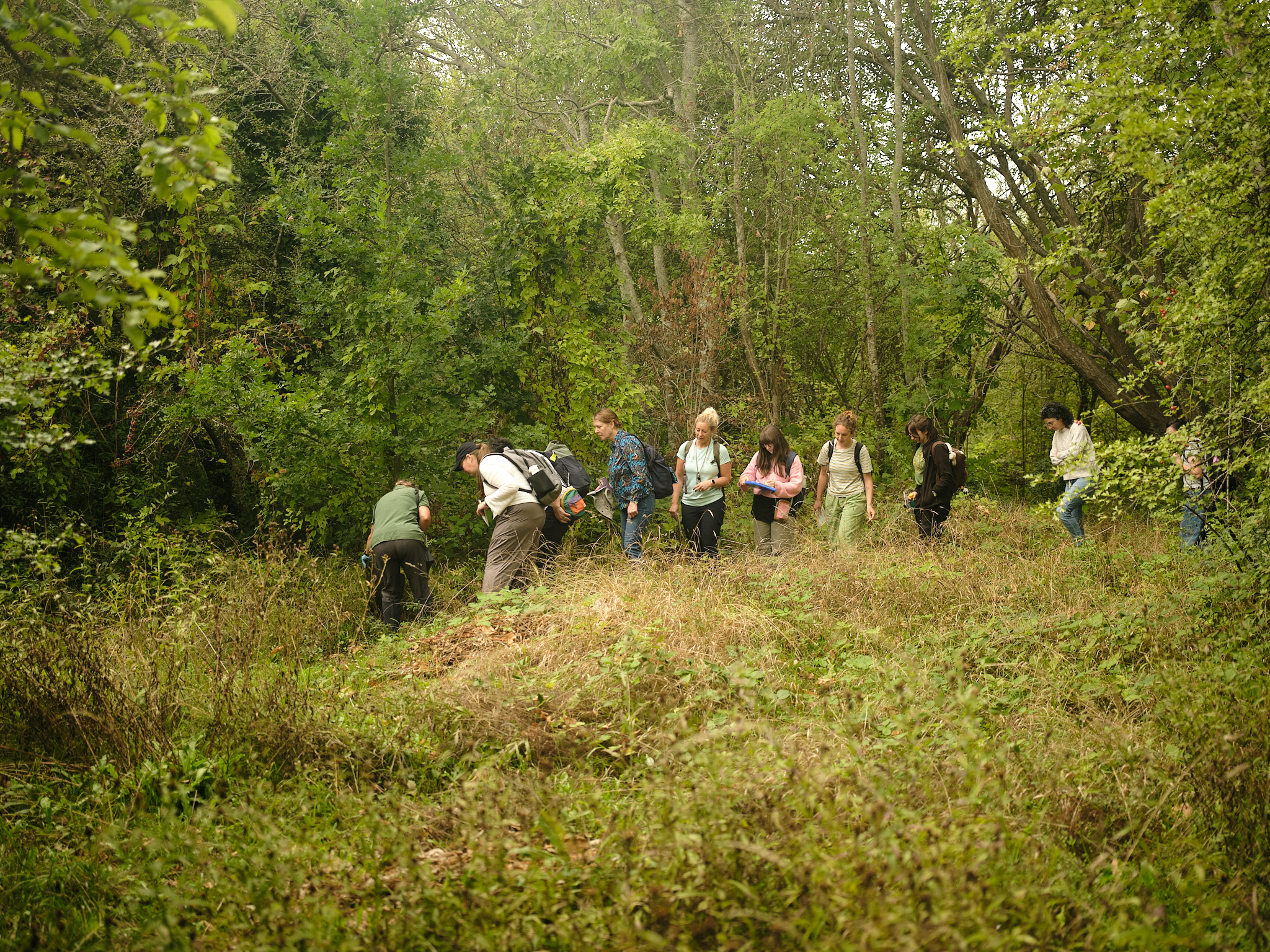
Teaching is structured around five core modules covering wildlife ecology and behaviour, species and biodiversity monitoring, population management, habitat assessment, and human populations and conservation. These are followed by a two-part, customised research project in which students analyse their own data to investigate specific conservation questions. Alongside rigorous training in field survey methods, data analysis and reporting, students develop a broad range of practical skills, including first aid, fundraising and scientific writing. The small cohort size ensures close interaction with staff and one-to-one supervision throughout the research project.
The course draws on more than three decades of WildCRU’s leadership in conservation research and practice and is jointly managed with Oxford Lifelong Learning. It is made possible through the support of the Recanati–Kaplan Foundation through Panthera.
Please visit the WildCRU website for further details of the Postgraduate Diploma in Wildlife Conservation.
Applications are particularly welcomed from conservationists working in economically less-developed parts of the world, for whom need-based scholarships are available. Suitable candidates are early-career field conservationists, working with government agencies or NGOs, who will implement and disseminate their skills to their home countries. Conservationists working in biodiversity-rich developing nations are particularly welcome to apply.
The course is not suitable for individuals who are not currently working in an ecology or conservation research role. For entry-level ecology and wildlife conservation courses, please see the short courses in the natural sciences run by Oxford Lifelong Learning.
Within the eight-month course, the first three-month phase consists predominantly of taught material, while the remaining five months are a mix of taught material and independent work on projects.
The independent research project concentrates on the organisation, analysis and reporting of previously collected data that you bring with you or that is provided by WildCRU researchers. There is no time to undertake primary data collection in-country or abroad during the course duration.
The project is divided into two phases:
- Phase One consists of a literature and methods review and a section containing data exploration.
- Phase Two builds upon this but also includes the full data analysis and discussion of results.
Unifying threads running through the course are the global and human dimensions of biodiversity conservation. You will learn both the theory and practical aspects of field techniques, so that you can confidently adopt them in the future, as well as critically evaluate other projects.
- The Course Director is Professor Claudio Sillero, Deputy Director of WildCRU.
- The Course Coordinator and Lead Tutor is Dr Egil Dröge.
- Dr Paul Johnson is a Senior Tutor.
- Dr Jorgelina Marino is the Welfare Tutor.
- Professor Amy Dickman, WildCRU Director, and Professor David Macdonald, WildCRU Founder, are also tutors on the course.
WildCRU PhD students also often collaborate on Diploma research projects and provide insight from their experience. In addition to these WildCRU members, the Diploma benefits from external colleagues who join us as guest tutors and mentors.
Assessment is through the two reports of the independent research project and four assignments. Most assignments will be short-answer questions, presenting data to be analysed, scientific research to critique, a problem for which you will design solutions, or information to be synthesised into a brief report/recommendation.
Degree-level qualifications
As a minimum, applicants should hold or be predicted to achieve the following UK qualifications or their equivalent:
- a first-class or strong upper second-class undergraduate degree with honours in a biology/natural resources-related field.
In exceptional cases, demonstrably equivalent professional experience in wildlife conservation may be considered.
For applicants with a bachelor’s degree from the USA, the minimum overall GPA that is normally required to meet the undergraduate-level requirement is 3.6 out of 4.0.
If your degree is not from the UK or another country specified above, visit our International Qualifications page for guidance on the qualifications and grades that would usually be considered to meet the University’s minimum entry requirements.
English language proficiency
This course requires proficiency in English at the University’s higher level. If your first language is not English, you may need to provide evidence that you meet this requirement. Further information on English language requirements can be found here.
Please visit the PGDip in Wildlife Conservation (Recanati-Kaplan) page on the University of Oxford Graduate Admissions website for details of course fees and costs.
Due to the specialist nature of the course and its entry requirements, it is recommended that you send your CV to the Course Co-ordinator using the email address wildcru.diploma@biology.ox.ac.uk before you start your application with the University.
Please see our funding page for help and information with regard to funding postgraduate studies. We further recommend that applicants search for funding opportunities via the online Fees, Funding and Scholarship search tool.
In order to be considered for many scholarships, applicants are required to apply by the January deadline. However, applicants should note that some scholarships require additional application materials and may have different deadlines, so applicants should make sure they check the application process for each scholarship carefully.
Scholarships
Various scholarships are available for Global South students. These include scholarships from the Arabian Leopard Fund for Middle Eastern students, a Tang Scholarship for a Chinese National, and Burnett Scholarships for African students. Depending on the amount of own or third-party funding secured by candidates, applications can be made for any or all of the following costs:
- Course fees
- International travel, to and from the UK
- Accommodation
- Living expenses for the duration of the course
Please visit the WildCRU website for further details regarding the available scholarships.
Applications for this course should be made via the University of Oxford Graduate Admissions website. This website provides information on fees and entry requirements, along with help on preparing and submitting your application.
Application deadlines
12:00 midday UK time on:
- Stage 1: Wednesday 27 January 2027 (Latest deadline for most Oxford scholarships)
- Stage 2: Tuesday 2 March 2027
When to apply
Early application for the programme is strongly advised. After the March deadline, the course will only stay open for that year’s entry if places are still available.
Remember that it can take a number of weeks to obtain all of the documents you need and to prepare a competitive application. You should also allow your referees plenty of time to submit your references. We therefore recommend you apply as soon as possible.
Interviews are normally held as part of the admissions process within six weeks of the application deadline.
Contact us
Due to the specialist nature of the course and its entry requirements, it is recommended that you send your CV to the Course Co-ordinator at wildcru.diploma@biology.ox.ac.uk before you start your application with the University.