
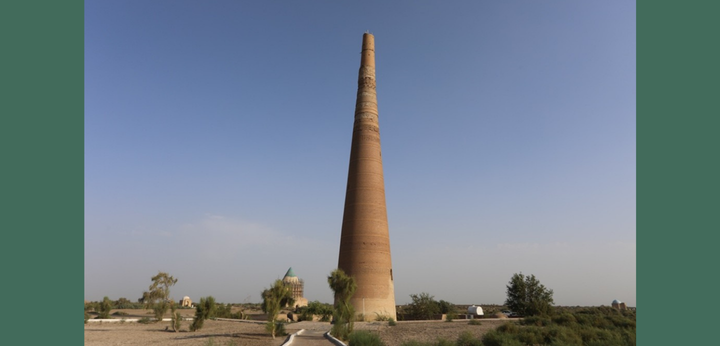
Departmental Tutor in Archaeology, Dr Katie Campbell, tells us about her summer spent as part of a ‘travelling seminar’ in Central Asia to see how the Mongol conquests of the 13th century have affected cities in Uzbekistan and Turkmenistan. (Image: The abandoned city of Konye Urgench with the 60m tall minaret of Kutlug Timur which survived the Mongol conquest.)
‘I am part of the ‘Mongol Connections’ Getty-funded, connecting art histories project. We are a ‘travelling seminar’ of around 15 art historians, historians and archaeologists who research and teach the history, art and archaeology of Mongol Empire of the 13th-14th centuries.
‘This year we went to Central Asia to see how the Mongol conquests of the 13th century have affected cities in Uzbekistan and Turkmenistan. Highlights included Konye Urgench, a now-abandoned city which became an important capital under the Golden Horde, a Mongol state of the 13th-14th centuries, and the cities of Khiva, Bukhara, and Samarkand. Next year we will follow in the footsteps of Genghis Khan’s descendants and visit eastern Anatolia.
‘Back in the UK I organised a conference for colleagues from a 3-year research project funded by the British Institute for Persian Studies entitled “Archaeological Approaches to Urbanism and Urban Sustainability in ‘medieval’ Central Asia”. It was a great day, exchanging information on urbanism in southern Kazakhstan over the past 2000 years.’
Learn more:


