
Short course
Campaigns and Causes in Britain, 1900-1950

Course status:
Applications being accepted


Dates and time:
22/02/2027 - 22/03/202716:30 - 18:30

Study format:
In-person weekly

Fees:
£190.00
What motivated people to volunteer their time to campaign for causes in the first half of the twentieth century?
This five-week course looks at voluntary movements, campaigns, and initiatives connected to conflicts, social causes, leisure, and community life. These campaigners are examined in terms of the history of 'associational culture' – the way in which people grouped together with like-minded people to organise for collective action.
Classes will include a mixture of lectures and class-based discussion, with optional reading. Why did people volunteer their time to campaign for causes in the first half of the twentieth century? Set in the context of the longer history of voluntary movements and campaigns in the eighteenth and nineteenth centuries, topics which we will explore in more detail include the work of major national societies such as St John Ambulance and the British Red Cross Society, the growth of communities such as cycling clubs and the Ramblers' Association, and the expansion of voluntary associations leading up to and during the Second World War, such as the Women's Voluntary Service and Oxfam.
Book this course
Book your place online using the button below.
Contact the team
Phone: +44 (0)1865 280900
Course starts Monday 22 February 2027
This is an in-person course which requires your attendance at the weekly meetings in Oxford on Mondays, 4.30-6.30pm.
Week 1: The longer history of campaigning
Looking at examples from the eighteenth and nineteenth centuries, including the anti-slavery movement, the Royal Humane Society, the Royal National Lifeboat Institute, and animal rights, we will explore the longer history of charitable organisations which relieved suffering. We will also consider the growth of voluntary action and popular campaigning in Britain more broadly, including the ways in which ordinary people organised around various social causes.
Week 2: The First World War
How did charities prepare for war and how did they campaign to relieve suffering? We will explore the organisation of voluntary aid, fundraising, recruitment, and wartime humanitarian work at both national and local levels. We will also consider associations in the aftermath of the war, including movements which contributed to the founding of the British Legion and Save the Children.
Week 3: Voluntary Associations in Interwar Britain
The interwar period saw the continued growth of voluntary organisations, clubs, and campaigning groups across Britain. This class will explore associational culture. We will examine campaigns connected to access, leisure, citizenship, welfare, and community life, alongside the social importance of belonging, identity, and collective action within these organisations.
Week 4: Preparing for a Second World War
Joining the group of charities which we have already explored, in 1938, the Women’s Voluntary Service was founded as the Women’s Voluntary Services (WVS) for Civil Defence. What kind of activities did the members of these organisations do during the Second World War and how did volunteers feel about their work?
Week 5: Fighting famines
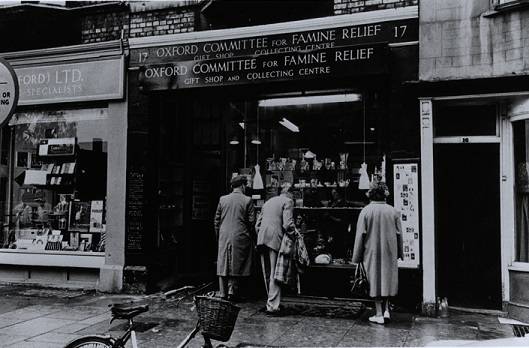
Oxfam’s first meeting was in 1942 as the Oxford Committee for Famine Relief. This session looks at how our city’s famine relief society started an internationally significant charity in wartime and post-war years. We will also consider how other local committees, volunteers, churches, student groups, and civic networks helped to organise relief campaigns at the community level.
Course aims
Course aim:
To explore a variety of organisations’ contributions to British civic society, examining the role of volunteers and the campaigns and causes for which they gave their time.
Course objectives:
- To understand the longer history of voluntary action, campaigning, and associational culture in the UK
- To explore examples of organisations and movements connected to humanitarianism, welfare, leisure, access, and social causes
- To examine the role of some of the major charities and organisations active in times of war
- To understand the terminology of the study of voluntary organisations, including civic society and associational culture/life
- To experience studying through discussions in class as well as through lectures
- To consider the use of primary sources to explore the history of campaigning and voluntary action in Britain
Learning outcomes
- To be able to demonstrate an understanding of the development of voluntary organisations which campaigned to mitigate suffering in the context of wider British and international history.
- To understand associational life and the groups to which people belonged, including organisations connected to leisure, access, welfare, humanitarianism, and social causes.
- To understand the ways in which voluntary organisations, campaigning groups, and associational culture have been explored by historians.
- Reflect on the use of primary sources for understanding the motivations of campaigners.
Level and demands
The Department’s Weekly Classes are taught at first year undergraduate level.
Teaching methods
The course will be taught through a combination of tutor-led presentations and group discussion. Recommendations for reading and listening will be provided to the class in order to prepare for weekly classes.
Assessment methods
This course is not accredited, so there are no assessments or coursework.
Dr Rosemary Cresswell
Dr Rosemary Cresswell is a Departmental Lecturer in Lifelong Learning (History). She is a historian of health, humanitarianism, charity and voluntarism from 1850-2020. She is currently writing the History of the British Red Cross, 1870-2020: Health and Humanitarianism, to be published by Bloomsbury. Rosemary has also published further research related to infectious disease, first aid, the Red Cross, and on the history of nursing.
Read Rosemary’s full academic bio.
Dr Matthew Kidd has taught in the Department since 2019. He has held various positions at the University of Oxford, including leading two major projects that preserved and digitised stories and artefacts from the First and Second World Wars. His research primarily focuses on nineteenth- and twentieth-century English history, with a particular emphasis on how ordinary people interpreted and articulated political movements, parties, ideas, ideologies, and identities at the local level. Matthews current research has a sharper focus on memory, oral history, and the use of AI and digital humanities methods.
Read Matthew’s full academic bio.
Dr Matthew Kidd
Matthew Kidd is an early career researcher whose research focuses on issues of class, identity and ideology in modern Britain. He has published articles and book chapters on wartime socialism and the conceptual framework of labourist ideology, and his first book, The renewal of radicalism: politics, identity and ideology in England, 1867-1924, was published in 2020 by Manchester University Press. Matthew currently works at the University of Oxford where he co-ordinates the follow-up to the award-winning ‘Lest We Forget’ digital archive project.
Digital badge
Upon successful completion of this course, you will be issued with an official digital badge from the Department for Continuing Education, University of Oxford. In order to be issued with your badge, you will need to have attended at least 80% of the course.
After the course, you will receive an email with a link and instructions on how to download your digital badge. You will be able to add this badge to your email signature and share it on social media if you choose to do so.
Fees
| Description | Costs |
|---|---|
| Course fee | £190.00 |
Funding
If you are in receipt of a UK state benefit, or are a care-leaver in the UK, you may be eligible for a reduction of 50% of tuition fees. Please see the below link for full details:
Concessionary fees for short courses
Recommended reading
Recommended reading is optional and you are not required to purchase these books to study this course.
Library facilities
All short course students (online and in-person) may register to borrow from the Oxford Lifelong Learning Library, for the duration of their course.
Further information about the Oxford Lifelong Learning Library can be found on the library website.
Preparatory reading
- ‘Living Humanitarian Dreams: The Oneiric and Spiritual Life and Activism of Elizabeth Wilson’ / Bertrand Taithe and Adam Millar
Module code: O26P492LHW
How to enrol
Please use the ‘Book now’ button on this page.