
Short course
The Economic impacts of Artificial Intelligence: Productivity, jobs and society

Course status:
In progress - closed to new applications


Dates and time:
01/10/2026 - 03/12/202616:30 - 18:30

Study format:
In-person weekly

Fees:
£315.00
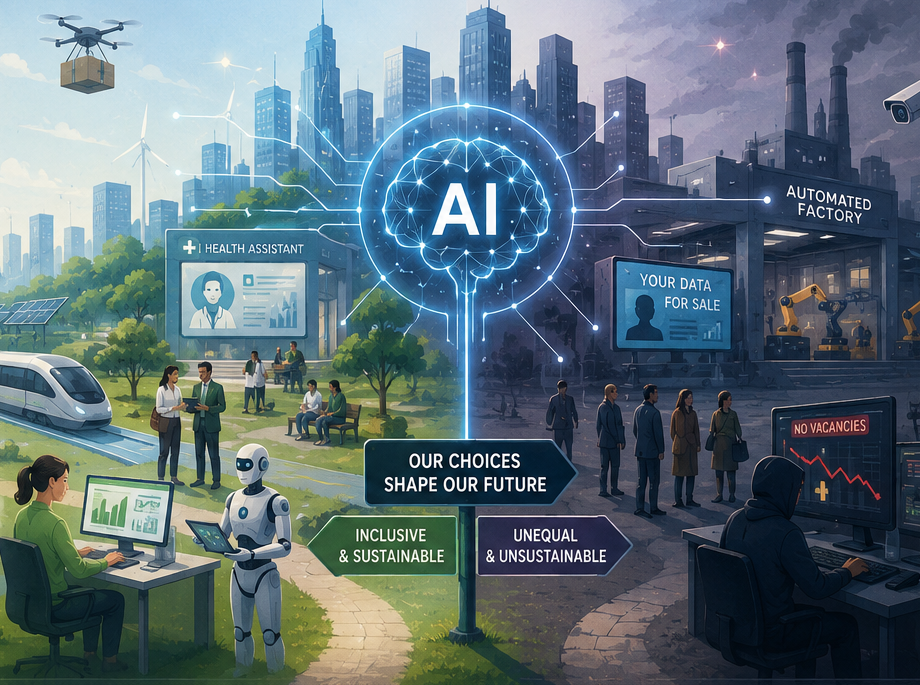
Technological transitions have transformed the economy and wider society. From the industrial revolution to the internet the impacts can be far-reaching and unanticipated. Some think that Artificial Intelligence will produce another revolutionary transformation that will change everything. Some think that the changes will be hugely beneficial, others that the results will be disastrous. A further view is that there will be minimal change as a result of AI and that there is a lot of hype when impacts will be minimal. The range of possibilities are immense, from utopia to dystopia.
Some of those possible outcomes generate a lot of concern, either because it is one in which all of society will suffer greatly, or because they worry that it will be them who gets will be left behind or left worse-off. Decisions being made now could impact the future for the individual making a choice about what investments to make (in skills or capital), and for social policy to ensure a safe and just future.
This 10-week short course introduces adult learners to the economic impacts of artificial intelligence. No previous economics knowledge is required. Students will explore how AI may affect productivity, jobs, careers, wages, inequality, business power, public services, and social policy. The course focuses on possible future scenarios rather than one single prediction, asking who is likely to benefit and who may be at risk. We can then consider what choices governments, employers, workers, and citizens can make. Through accessible economic concepts, real-world case studies, and scenario-building exercises, students will develop the tools to think critically about AI and the future economy.
Course starts Thursday 1 October 2026
This is an in-person course which requires your attendance at the weekly meetings in Oxford on Thursdays, 4.30-6.30pm.
Week 1: What is AI and how might it impact “the economy”?
Week 2: A beginner’s guide to labour markets
Week 3: Automation, augmentation, and productivity
Week 4: Wider impacts: Possible future scenarios
Week 5: Labour and careers: Which skills, jobs and careers are most exposed?
Week 6: Inequality: who benefits and who gets left behind?
Week 7: Ownership, firms and markets: Who stands to benefit from agentic AI?
Week 8: Social concerns: Environmental impacts, care, public services, and unpaid work
Week 9: Policy choices: shaping the AI economy
Week 10: Summary: What might the future be like?
Course aims
Learn the potential impacts of AI on the economy and society, and the possible responses to these impacts.
Course objectives
- Understand the possible economic futures arising as a result of Artificial Intelligence
- Identify how these futures would impact on different groups in society
- Present and defend their own views on possible AI futures and appropriate policy responses
Learning outcomes
- Outline the possible impacts of AI on the economy and society in terms of basic economic concepts
- Analyse how AI could affect wages, career ladders, job quality, and worker bargaining power
- Evaluate and defend policy responses to disruption and inequality potentially arising from AI
Level and demands
The Department’s Weekly Classes are taught at FHEQ Level 4, ie first year undergraduate level, and you will be expected to engage in a significant amount of private study in preparation for the classes. This may take the form, for instance, of reading and analysing set texts, responding to questions or tasks, or preparing work to present in class.
Teaching methods
Students will be asked to engage with one or two relevant texts each week before class, plus other materials as relevant. Classroom sessions will consist of a mixture of activities including active lecturing, small group discussion and open debate.
Assessment methods
Only those students who have registered for assessment and accreditation, in advance of the course start date, can submit coursework/assignments for assessment.
Assessment
You will be set two pieces of work for the course. The first of 500 words is due halfway through your course. This does not count towards your final outcome but preparing for it, and the feedback you are given, will help you prepare for your assessed piece of work of 1,500 words due at the end of the course. The assessed work is marked pass or fail.
Dr Doug Bamford
Doug Bamford is lecturer in Lifelong Learning (Political Philosophy) at OUDCE, teaching courses in philosophy and political economy. His main interest is in political philosophy and its application to public policy, particularly taxation. He obtained his PhD in 2013 and became an Associate Fellow of the Higher Education Academy (AFHEA) in 2023. He is author of Rethinking Taxation (Searching Finance, 2014) and several papers (including articles in the Journal of Applied Philosophy, Moral Philosophy and Politics, Problema, and Think). He blogs at Doug Bamford’s Tax Appeal.
Academic credit
Credit Accumulation Transfer Scheme (CATS Points)
Please note, students who do not register for assessment and accreditation during the enrolment process will not be able to do so after the course has begun. If you wish to gain credit from completing this course you must register to do so before the course starts.
Only those who have registered for assessment and accreditation will be awarded CATS points for completing work to the required standard. Please note that assignments are not graded but are marked either pass or fail.
Learn more about the Credit Accumulation Transfer Scheme.
If you are enrolled on the Certificate of Higher Education at the Department you need to indicate this on the enrolment form but there is no additional registration fee for assessment and accreditation.
Digital certificate of completion
Students who are registered for assessment and accreditation and pass their final assignment will also be eligible for a digital Certificate of Completion. Information on how to access the digital certificate will be emailed to you after the end of the course. The certificate will show your name, the course title and the dates of the course attended. You will be able to download the certificate and share it on social media if you choose to do so.
Fees
| Description | Costs |
|---|---|
| Course fee (with no assessment) | £315.00 |
| Assessment and Accreditation fee | £60.00 |
Funding
If you are in receipt of a UK state benefit, or are a care-leaver in the UK, you may be eligible for a reduction of 50% of tuition fees. Please see the below link for full details:
Concessionary fees for short courses
Recommended reading
Recommended reading is optional and you are not required to purchase these books to study this course.
Library facilities
All short course students (online and in-person) may register to borrow from the Oxford Lifelong Learning Library, for the duration of their course.
Further information about the Oxford Lifelong Learning Library can be found on the library website.
Preparatory reading
- Prediction machines, updated and expanded: The simple economics of artificial intelligence / Agrawal, A., Gans, J., & Goldfarb, A.
Module code: O26P494SOW
How to enrol
Please use the ‘Book now’ button on this page.
How to register for accreditation and assessment
To be able to submit coursework and to earn credit (CATS points) for this course, if you wish to do so, you will need to register and pay an additional £60 fee. You can do this by ticking the relevant box at the bottom of the enrolment form or when enrolling online.
Students who do not register for CATS points during the enrolment process will not be able to do so after the course has begun.
If you are enrolled on the Certificate of Higher Education at the Department you need to indicate this on the enrolment form but there is no additional registration fee.