
Getting started with insect sampling and identification

Online resource funded by NERC
This resource was developed as part of the doctoral research training course ‘Insect Taxonomy and Field Sampling Skills’, a blended learning short course that took place in summer 2025.
The course was generously funded by NERC via their 'delivering training courses for environmental scientists 2024' funding opportunity.
It was led by Zoë Simmons (Oxford University Museum of Natural History) and Thomas Hesselberg (Oxford Lifelong Learning, University of Oxford) and expertly taught by Steven Falk and Liam Crowley.
Introduction to the resource
It is now well documented that most insect populations are declining at an alarming rate both globally and in the UK, which, if unchecked, will have severe impacts on most ecosystems as well as having significant economic impacts due to insects' vital roles in key ecosystem processes such as pollination and in pest control.
In order to have any hope of reversing this decline, we need both to employ the most appropriate surveying techniques to monitor insect population changes and we need high-level taxonomic expertise to accurately identify the species sampled to assess their conservation status. Sadly, we are currently lacking this expertise, so it crucial that we get more people interested in developing these skills.
The resources complied here can be viewed as a mini taster course to get people started on the journey to develop advanced insect sampling and identification skills. While the resources are primarily aimed at university students, ecological consultants and conservationists just starting out in their careers, it can used by anybody with an interest.
The resource is structured in a logical manner starting with collecting the insects, where the Sampling and Surveying Insects section gives a comprehensive overview of the common field survey techniques used by entomologists as well as a lecture on some modern molecular techniques.
Following on from collecting the insects, they then need to be sorted, and the Sorting and Preparation of Specimens section gives an introduction to how the samples can be effectively sorted and specimens prepared and pinned for later identification. This is done via bespoke guides and videos as well as publicly available lecture.
The Identifying Insects section introduces the taxonomic breath and diversity of insects while providing specific beginner guidance to general insect identification via ID guides and two publicly available lectures.
Finally, in the Test Your Knowledge section, you get an opportunity to test your learning by taking multiple choice quizzes, identifying the most suitable surveying techniques and identifying a couple of specimens from photographic material.
Most importantly, however, to the goal of training more entomologists, is the Further Resources section where you can find information on relevant societies to join, further courses to follow and relevant literature to build upon introductory information covered here.
Quick links
Sampling and surveying insects
Insect surveying and sampling are fundamental for a very diverse range of purposes including for basic research as well as understanding biodiversity, ecosystem function, and environmental change.
Systematic sampling also provides baseline data and detects population trends, which helps inform conservation and habitat management decisions, and enables early identification of invasive or pest species.
Insect sampling can be split up into active methods, which involve active collection by the surveyor and are time limited, and passive methods, which collect data without active human presence potentially over longer time periods.
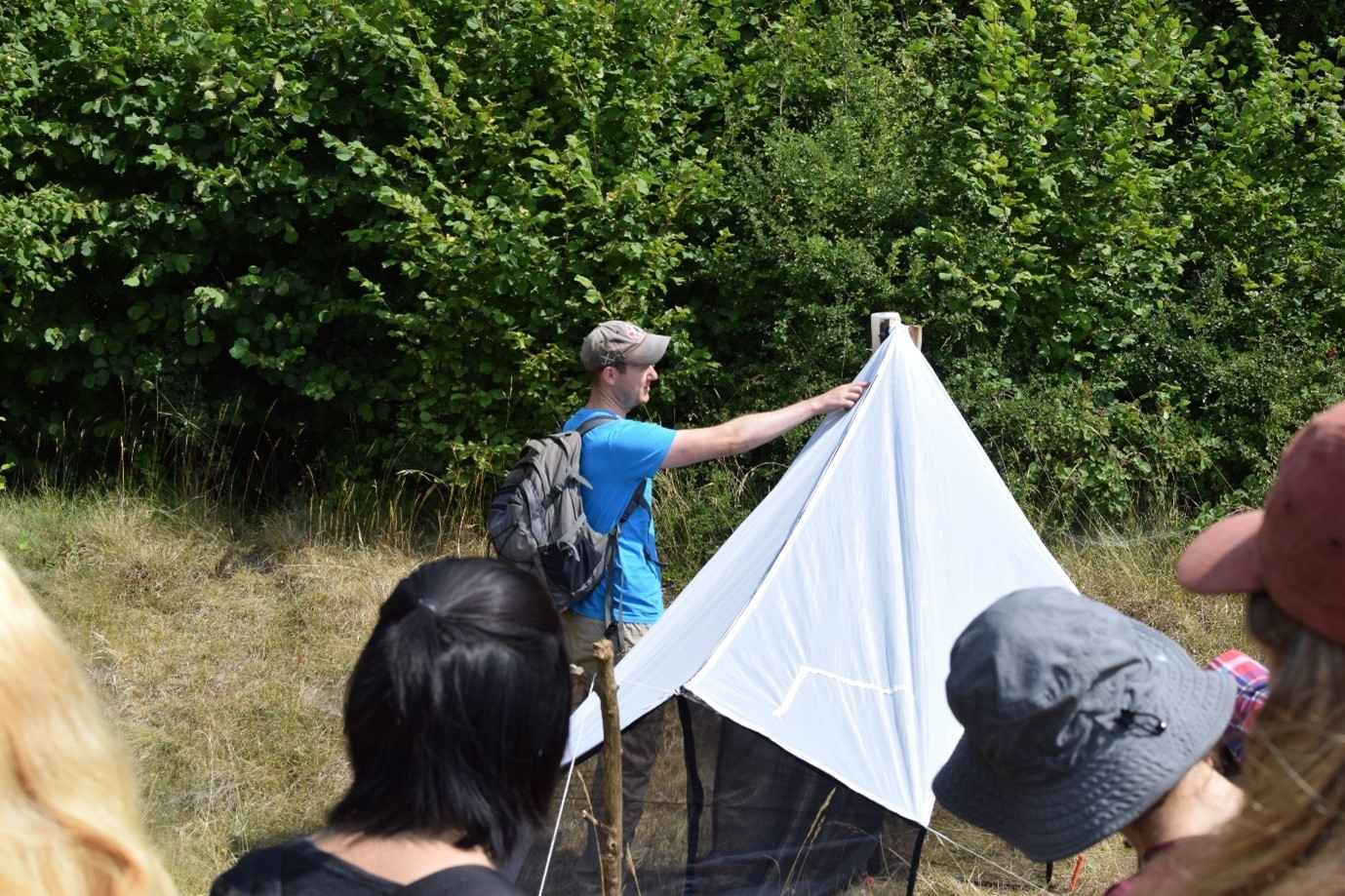
Photo: Liam Crawley showing students how to set up a Malaise trap in July 2025. Photo: Thomas Hesselberg.
Active methods of insect sampling – targeted searching
- Targeted searching is based on the known ecology of species and reduces time and resources while potentially providing ‘value added’ observations on the ecology and behaviour of the target insect.
- Field signs includes looking for indirect presence such as feeding damage on plants, exit holes in decaying wood, nests.
- Specimens may be pooted or otherwise collected directly from their microhabitat.
Active methods of insect sampling – extractive sampling
- Various types of netting – sweep, aerial/butterfly, water and plankton nets.
- Beat sampling involves a white sheet held below a bush, tree branch or other vegetation that is vigorously shaken or beaten with a stick.
- Vacuum or suction sampling is a technique where a suction device such as an inverted leaf-blower is used to collect ground-dwelling insects.
- Canopy fogging involves fumigating the canopy of trees with insecticides and collecting insects on a large sheet as they fall.
- Kick sampling for aquatic insects involves placing a net downstream of stones or other substrate that is then disturbed by kicking it.
- Laboratory techniques for extracting invertebrates from samples of substrate or food plants including Tullgren and Berlese funnels.
Passive methods of invertebrate sampling – trapping
- Pan traps are liquid-filled coloured pans that attract pollinators.
- Pitfall trapping is used for surveying active ground-dwelling insects.
- Light traps are primarily used for surveying moths and other nocturnal insects that are attracted to light.
- Malaise traps are tent like structures for surveying flying insects by intercepting their flight paths and funnelling up into a collection pot.
Lecture
*Coming soon* Lecture from Dr Liam Crowley, University of Oxford, from 2025 on how modern molecular methods are used for monitoring insects.
Sorting and preparation of specimens
Careful sorting and preparation are fundamental steps in entomology because the scientific value of an insect specimen depends on how it is handled after collection. Poorly sorted or badly prepared material quickly loses its usefulness: specimen can deteriorate and diagnostic features become damaged or obscured.
Sorting allows specimens to be grouped by major taxonomic features, size, and condition, which reduces handling damage and ensures that appropriate preparation methods are used for different insects. For example, small, soft-bodied and fragile insects require very different treatment compared to large heavily sclerotised insects. Early, careful sorting also helps separate target specimens from by-catch and debris, improving efficiency and accuracy later on.
Proper mounting and pinning preserve an insect’s structure in a stable, examinable position ensure that key identification characters are visible and accessible, both now and in the future. Well-prepared specimens can be re-examined as identification methods improve, or used for comparison, teaching, and reference collections.
Accurate labelling is just as important as the physical preparation. Without clear information on where, when, and how a specimen was collected, even a perfectly prepared insect has little scientific value. Together, careful sorting, preparation, and labelling ensure that insect samples remain informative, verifiable, and useful long after they leave the field.
Resources
Here are some useful resources to get you started with sorting and preparing your own collected specimens, created by Zoë Simmons.
1. Documents describing how to mount, pin and label your specimens:
- Intro to specimen preparation (pdf): A brief overview of the different kinds of mounting used in the preparation of entomological material
- Pinning – How to (pdf): A comprehensive guide with choice key
- Labelling specimens (pdf): Instructions on how to label specimens
- Data label template (Word). Pre-formatted word document for creating labels
2. Accompanying videos demonstrating how to pin and mount your specimens:
*Video links coming soon*
- Video 1: Direct pinning with commentary
- Video 2: Direct pinning - different orders
- Video 3: Micro-pinning with commentary
- Video 4: Point mounting with commentary
- Video 5: Point mounting the silent version
- Video 6: Card-mounting with commentary
3. See also this EntoLIVE webinar from Ashleigh Whiffin, Curator of Entomoly at the National Museums Scotland, on the value of insect collections in research (from 2023).
Identifying insects
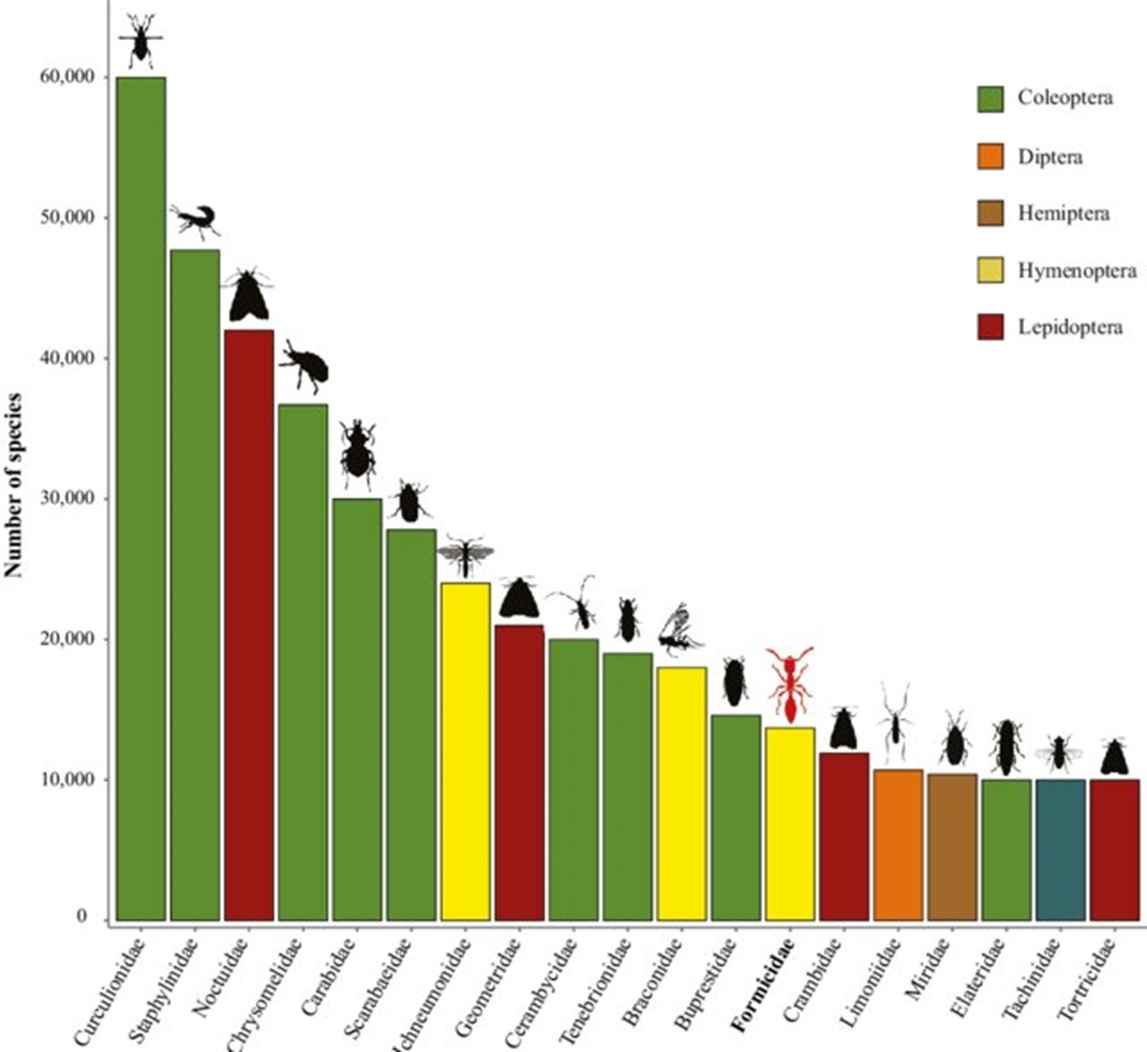
Image: The most species rich insect families in the world. Taken from Fernandez, F., Guerrero, R. J. and Sanchez-Restrapo, A. F. (2021). Systematics and diversity of Neotropical ants. Revista Colombiana de Entomología 47: e11082
Insect taxonomy deals with the description and classification of an extremely large and unevenly distributed component of animal diversity. Insects belong to the class Insecta within the phylum Arthropoda and currently include approximately 1 million described species, representing over 50 percent of all formally described animal species. Estimates of total insect diversity range from 3 to 10 million species with many species, particular in the tropics, waiting to be discovered and described.
At the highest taxonomic level, insects are divided into around 30 extant orders, although the exact number varies slightly among classification systems. A small number of orders dominate species richness. Coleoptera (beetles) alone accounts for roughly 400,000 described species, followed by Lepidoptera (moths and butterflies, ~160,000 species), Diptera (flies, ~160,000 species), and Hymenoptera (ants, bees, and wasps, ~150,000 species). Together, these four orders contain more than 70 percent of all described insect species.
Below the level of order, insects are classified into roughly a thousand families. Family-level diversity is also highly uneven. For example, the beetle family Curculionidae (weevils) includes over 60,000 described species, while many families contain fewer than 100. Family concepts are generally stable relative to species and genera, making this level particularly important for ecological and applied work where species-level identification may not be feasible.
The basic unit of taxonomy is the species, which represents a hypothesis about a reproductively or evolutionarily distinct lineage. Species are grouped into genera, with insect genera typically containing anywhere from a single species to several hundred, depending on the group and its taxonomic history. Species descriptions are based on diagnostic characters, most often morphological traits such as genital structures, wing venation, chaetotaxy, or mouthparts. For many insect groups, reliable species identification requires adult specimens and microscopic examination.
Modern insect taxonomy increasingly incorporates molecular data. DNA barcoding, most commonly using a fragment of the mitochondrial COI gene, has been applied to hundreds of thousands of insect specimens worldwide and is particularly effective for separating closely related or cryptic species. However, molecular data complement rather than replace morphology, as formal species descriptions still require diagnostic characters and reference specimens.
Taxonomic knowledge is unevenly distributed across insect groups and regions. Well-studied groups in temperate regions may have most species described, while tropical insects, especially small-bodied taxa such as parasitoid wasps and micro-Diptera, remain underrepresented in collections and literature. As a result, insect taxonomy is an active and expanding field, with thousands of new species described each year, driven by ongoing field sampling, revisionary work, and improved analytical tools.
Keys and online ID guides
-
Amateur’s Entomologists’ Society: Key to UK insect orders
-
Oxford University Museum of Natural History: How to identify insects using the internet
-
Royal Entomological Society: Classification of Insects
-
Steven Falk’s British Insects on Flickr
Lectures
- Aihlia Khan, University of Waterloo’s Ecology Lab: Insect Identification Webinar (2020)
- University of Illinois Extension Horticulture: What's That Bug? How to Identify Insects (2021)
Resources
- UK Beetle Recording: www.coleoptera.org.uk
- British Bugs: www.britishbugs.org.uk
- UK Moths: www.ukmoths.org.uk
- UK Butterflies: www.ukbutterflies.co.uk
- Dipterists Forum: www.dipterists.org.uk
- Bees, Wasps & Ants Recording Society: www.bwars.com/home
- The Sawflies of Britain & Ireland: www.sawflies.org.uk
- Orthoptera & Allied Insects: orthoptera.org.uk
- British Dragonfly Society (with resources for Damselflies): british-dragonflies.org.uk
- Lacewings and Allies Recording Scheme: www.laars.jamesjepson.com
- The Riverfly Recording Schemes: Trichoptera, Ephemeroptera and Plecoptera: www.riverflies.org/recording-schemes
- World Strepsiptera Database: strepsiptera.aphia.org
- Siphonaptera and Phthiraptera Recording Scheme: www.brc.ac.uk/scheme/siphonaptera-and-phthiraptera-recording-scheme
- Full list of wildlife recording schemes hosted by the Biological Records Centre: www.brc.ac.uk/recording-schemes
Test your knowledge
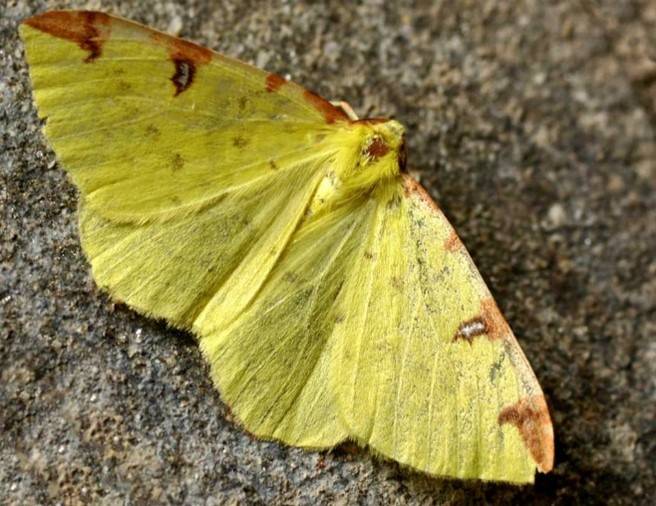
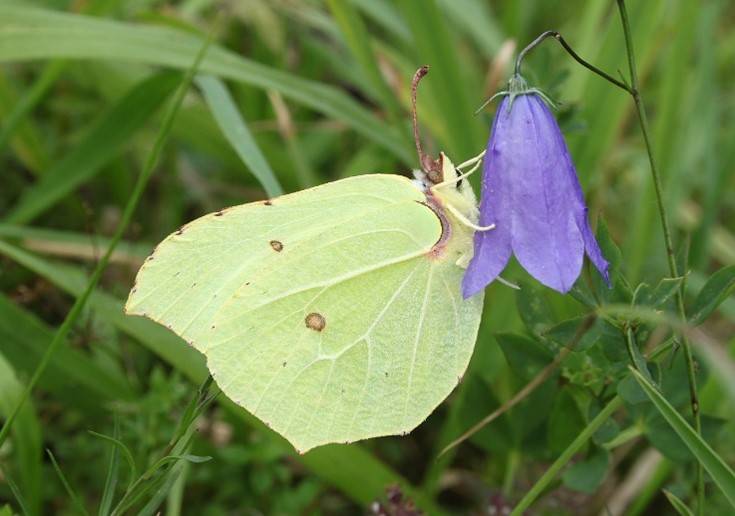
Which Brimstone is a moth and which is a butterfly? The image of the left is Opisthograptis luteolata while the image on the right is Gonepteryx rhamni. Look them up to see which is which!
Activities
Now that you have learned a bit about how to sample, sort and identify insects, here are some practical activities that you can do to test your knowledge and consolidate your learning.
Activity for beginners:
Test your learning with a multiple choice quiz, ecological survey scenarios and ID exercises.
Advanced activity:
Take a look at some digitised museum specimens from a variety of orders and families. How many can you identify to species?
Further resources
We hope that you have enjoyed this little taster to the wonderful world of insect surveying and taxonomy.
Now that you have hopefully developed an interest in this, below are some ideas on how you can take your newfound interest further including literature, online resources, learned societies and further courses, all with a UK focus.
Selected literature
Selected textbooks:
- Cullen, P. J. and Cranston, P. C. (2014). The Insects: An Outline of Entomology. Wiley-Blackwell.
- Many authors (2024). RES Insects - Discover the Science and Secrets Behind the World of Insects. DK
- McGavin, G. C. and Davranoglou, L.-R. (2023). Essential Entomology. Oxford University Press.
Selected ID Field Guides for UK insects:
- Brock, P. D. (2019). A Comprehensive Guide to Insects of Britain & Ireland. Pisces Publication
- Brock, P. D., John, T. C. and Mullen, P. (2026). Insects of Britain and Europe. Princeton University Press.
- Chinery, M. (2012). Insects of Britain and Western Europe. A&C Black
- Chinery, M. (2009). Collins Complete Guide to British Insects. HarperCollins.
- Tilling, S.M. (2014). A key to the major groups of terrestrial invertebrates. Telford, FSC Publications
- See also the very useful FSC field guides for specific groups.
Selected scientific papers:
- Crowley, L., Allen, H., Barnes, I., Boyes, D., Broad, G.R., Fletcher, C., Holland, P.W.H., Januszczak, I., Lawniczak, M., Lewis, O.T., Macadam, C.R., Mulhair, P.O., Pereira da Conceicoa, L., Price, B.W., Raper, C., Sivell, O. and Sivess, L. (2023). A sampling strategy for genome sequencing the British terrestrial arthropod fauna. Wellcome Open Research 8: 123.
- Crowley, L. M., Ivison, K., Enston, A., Garrett, D., Sadler, J. P., Pritchard, J. A., MacKenzie, A. R. and Hayward, S. A. L. (2023). A comparison of sampling methods and temporal patterns of arthropod abundance and diversity in a mature, temperate, Oak woodland. Acta Oecologica 118: 103873.
- Engel, M.S. and Kristensen, N.P. (2013). A history of entomological classification. Annual Review of Entomology 58: 585-607.
- Montgomery, G. A., Belitz, M. W., Guralnick, R. P. and Tingley, M. W. (2021). Standards and best practices for monitoring and benchmarking insects. Frontiers in Ecology and Evolution 8: 579193.
Online resources
Oxford Museum of Natural History has an impressive entomology collection. The museum also host some fun and informative learning resources on insects.
Steven Falk has an amazing photographic resource for insect identification (Flickr).
Natural History Museum London entomology collection.
Outside the UK, the Smithsonian Institution in the US provide a long list of resources.
Learned societies
With a UK focus we have:
- The Royal Society of Entomology is mainly aimed at professional entomologists and scientists.
- The British Entomological and Natural History Society is mainly aimed at professional and amateur natural historians with a specific interest in insects and other invertebrates.
- BugLife focuses on the conservation of insects and other invertebrates.
There are also a large number of smaller societies and organisations that specialise on specific insect orders including the following, as well as many others:
- Butterfly Conservation
- Dipterist Forum - the Society for the Study of flies
- British Dragonfly Society
- Colepterist Society of Britain and Ireland
Internationally, most countries have dedicated societies including the Entomological Society of America, which helpfully maintain a list of some of the larger international societies.
Courses
Oxford Lifelong Learning run a number of courses at different levels and lengths in ecology, conservation and animal behaviour that include insects.
- See our natural sciences courses for more information about the range of courses on offer.
- You may be intersted in our online postgraduate level course in Invertebrate Biodiversity and Population Monitoring Methods.
The Field Studies Council runs a lot of insect ecology and identification courses.
The Royal Entomological Society gives a brilliant overview of professional, undergraduate and postgraduate courses.
Acknowledgements
Thank you to the staff from the Oxford Museum of Natural History and Oxford Lifelong Learning for their help during the course itself and for their help in putting these resources together.


Top image: The Groove-faced Mining Bee (Andrena angustior). Photo by Steven Falk.

Natural sciences
Short, part-time and online courses in biology, physics, chemistry and other natural sciences at the University of Oxford.Ecological survey techniques
Flexible postgraduate and online courses in ecological survey techniques for professionals working in field surveys