
Short course
Theology Summer School

Course status:
Closed to new applications


Dates:
02/08/2026 - 15/08/2026

Study format:
Summer schools

Fees:
£1,350.00 – £4,050.00
Join us at Christ Church for a theology summer school on the theme of 'Christian Theology in Conversation with St Francis of Assisi’.
Marking 800 years since St Francis's death, our 2026 programme explores how his life and thought can help us engage with and examine issues that we face today. From St Francis's concern for the environment and creation to his engagement with the arts, seminars will consider how theology speaks into these areas while walking in the footsteps of St Francis.
You will enjoy lectures from leading scholars in the field of theology and take part in seminars led by members of Oxford University's Faculty of Theology and Religion, distinguished theologians and prominent church leaders.
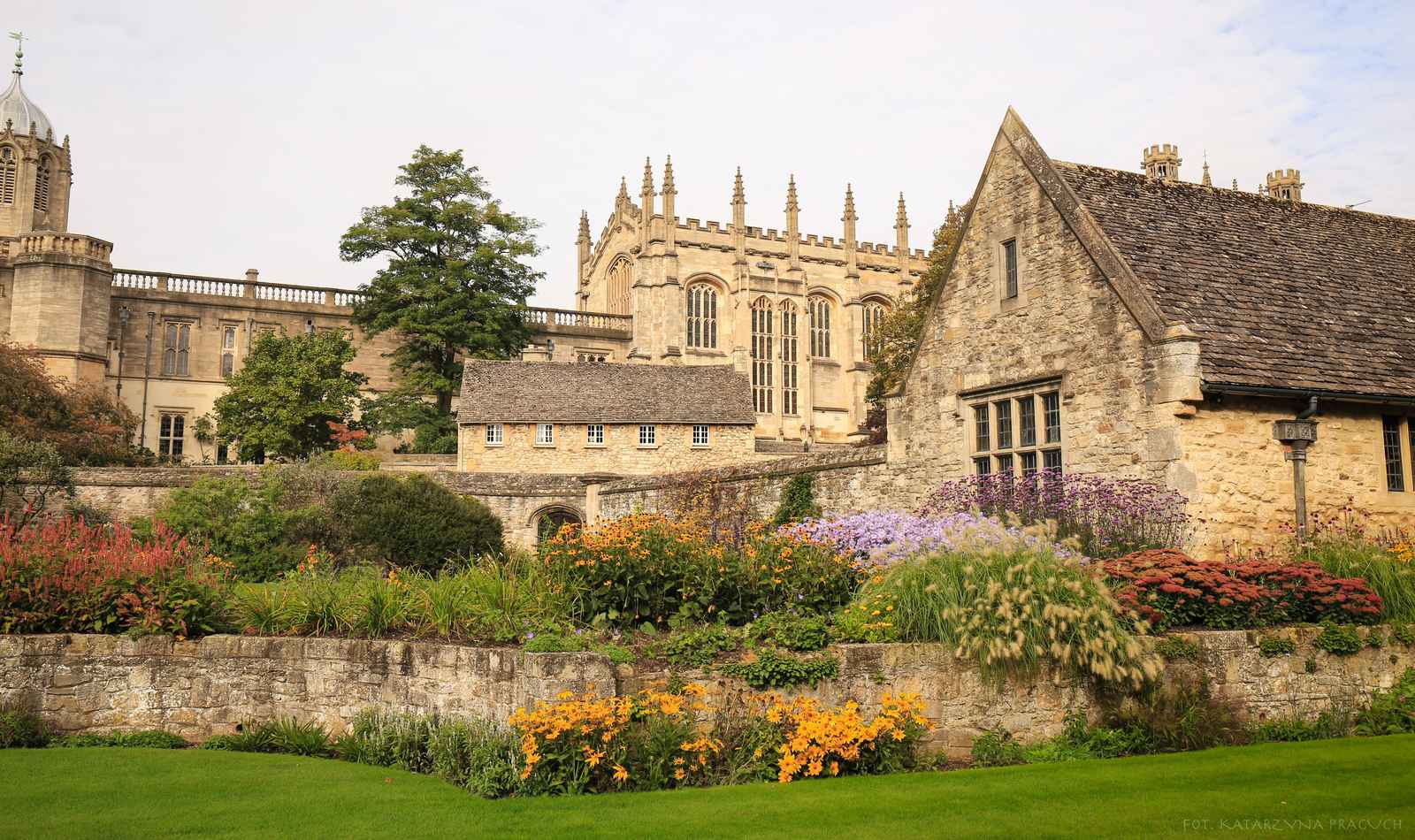
The course takes place in the centre of Oxford at Christ Church, one of the University's largest and most beautiful colleges, with both residential and non-residential options available.
The summer school runs over two weeks, with the option to attend the full programme or one week of your choosing.
A range of optional social events, provided at no extra cost, will ensure that you are fully immersed in the Oxford experience. Events include a welcome reception on the Sunday of your arrival, a walking tour of Oxford’s religious history, and a formal gala dinner to close each week of the programme.
Who is this course for?
The course is for theologians, teachers of religious education, religious leaders, members of the clergy, and lay ministers and readers.
While the focus of the summer school is Christian theology, religious leaders and members of other faiths are warmly welcomed.
Worship
Students are welcome to attend services at Christ Church Cathedral.
Oxford is a diverse city, rich in places of worship for people of many faiths and denominations.
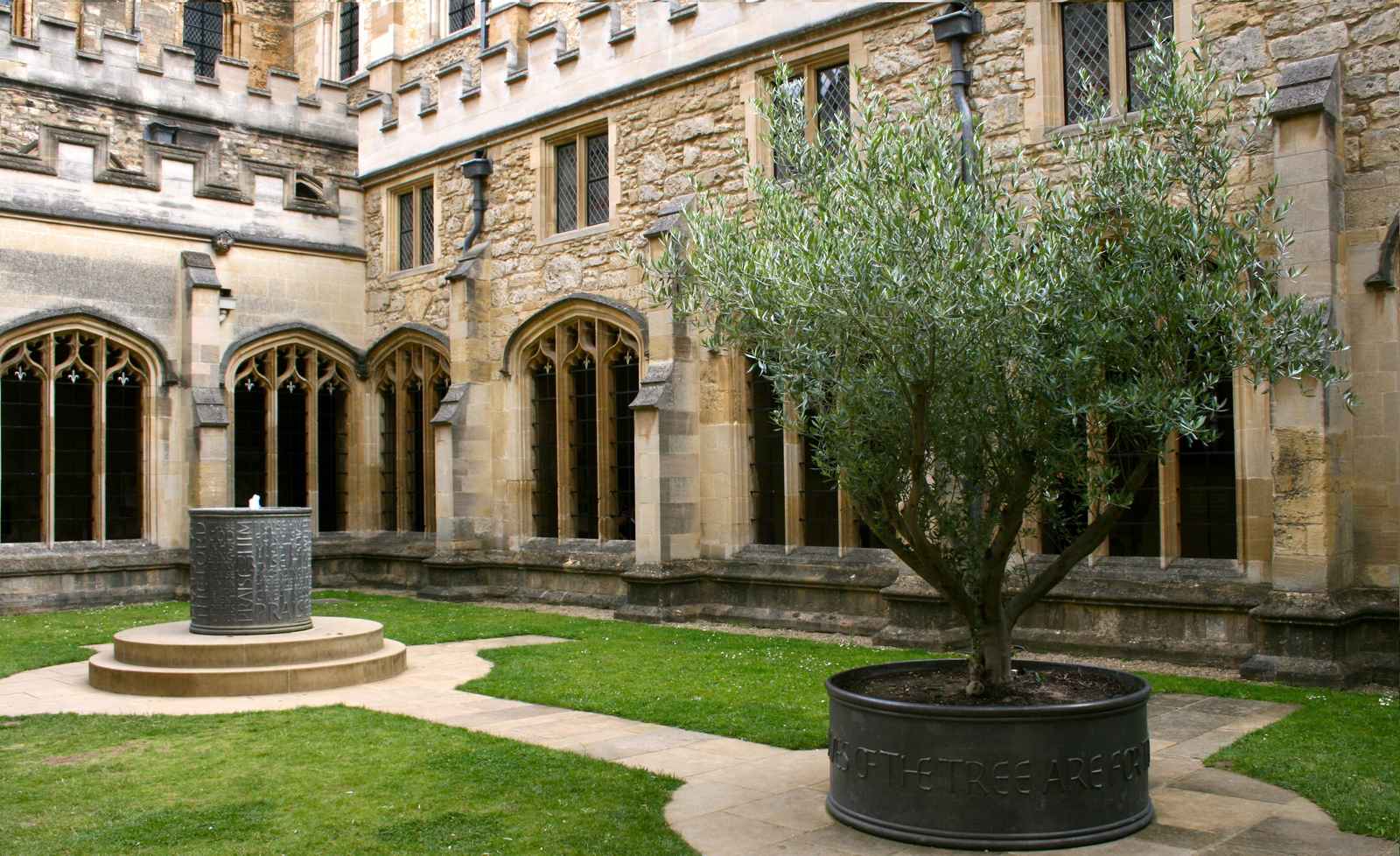
Image below: Christ Church Cloister Garden. The lead planter is inscribed with words from Revelations 22:2 ('The Leaves of the Tree are for the Healing of the Nations'), and contains an olive tree. The fountain represents peace and is inscribed with the words of Psalm 150.
Apply for this course
Apply using the button below.
Level and demands
Participants are expected to:
- undertake preparatory reading in advance of the programme;
- attend all seminar sessions and plenary lectures; and
- be actively engaged with their seminar topics.
Selection criteria
This is an intensive programme of study taught to an informed international audience aged 18 and over. Applicants should be confident that they are academically and linguistically prepared for such a programme.
Academic requirements
Applications are welcomed from:
- members of the clergy, especially as part of their continuing ministerial development;
- lay ministers and readers;
- theologians;
- teachers of religious education;
- those undertaking theological study at university level.
Although the focus of the summer school is Christian theology, religious leaders and members of other faiths are warmly welcomed as participants.
English language requirements
As students are expected to participate fully in seminar discussions and are required to produce written work it is important that applicants can demonstrate an appropriate level of proficiency in the four language skills – listening, reading, writing and speaking.
If your first language is English and you have always been a citizen of and primarily resident in a majority English-speaking country recognised by UK Visas and Immigration (UKVI), you do not need to demonstrate your level of English.
Applicants for whom English is not their first language must provide evidence of their proficiency in the form of an original certificate or a certified copy that is not more than two years old on the date the summer school starts. These applicants must satisfy one of the following requirements:
-
IELTS Academic – minimum overall score of 7.5, with not less than 7.0 in each of the four components. See IELTS English language test information.
-
TOEFL iBT – minimum overall score of 110, with not less than 22 for listening, 24 for reading, 25 for speaking and 24 for writing. See TOEFL English language test information.
-
C1 Advanced (formerly known as Cambridge English: Advanced or CAE) – minimum overall score of 191, with not less 185 in each of the four components. See Cambridge English language test information.
English language test waiver
The requirement to provide English language test scores may be waived in either of the following circumstances:
- Based on your previous education. If you have completed a full-time degree-level programme (bachelor’s, master’s or doctorate) at a recognised institution where teaching and assessment throughout the course was undertaken entirely in English, and the programme was completed with a gap of no more than two academic years to the start date of the summer school. If you studied this course in a country that is not majority English speaking, you will need to provide evidence that the course was taught in English. This can either take the form of a link to the appropriate page of the institution’s website or a statement from the institution confirming this.
- Based on your professional experience. If you have worked in person for a minimum of two years in a majority English-speaking country where the main language for the role was English; your role involved daily professional use of each of the four language components (reading, writing, listening and speaking); you worked in an appropriately technical context to demonstrate the ability to communicate effectively in an academic environment; and your role ended no more than two years before the start date of the summer school. You will need to provide a letter from your employer confirming this.
Accommodation
Residential options at Christ Church
Participants who choose to attend the summer school on a residential basis will have a single study bedroom. All rooms have private bathroom facilities (shower and toilet).
Bedrooms are located on the four floors of the 1960s-built Blue Boar Quad. Please note that Christ Church bedrooms do not have lift access, and the higher rooms can be located up a few flights of stairs. If you need a room on a ground or lower floor please indicate this on your application, or contact the programme administrator prior to your arrival.
Participants will take meals (breakfast Monday 4 August to Saturday 16 August for residential participants and dinner Sunday-Friday for all participants) in Christ Church’s spectacular dining hall. Each evening’s meal will be a served three-course dinner, with a five-course gala dinner on each Friday. Participants make their own arrangements for lunch. Should participants have any dietary requirements they are asked to complete the relevant section on the application form.
Participants cannot be accommodated at Christ Church either prior to or beyond their programme dates. Family members and/or friends who are not enrolled on this summer school cannot be accommodated in college.
Please be aware that accommodation at Christ Church is limited and may not be available for those who submit their applications towards the end of the admissions period.
Ground-floor accommodation
Christ Church does not have a lift and there are a limited number of ground-floor bedrooms. If you require a bedroom on the ground floor, or you have any access concerns, please contact the Programme Administrator at theologysummer@conted.ox.ac.uk.
Non-residential option
Students who choose to attend the summer school on a non-residential basis are responsible for finding their own accommodation. Information on accommodation in Oxford is available at:
Dinner is provided for non-residential participants at Christ Church from Sunday-Friday, and participants are welcome to attend all aspects of the social programme.
IT facilities
WiFi is available throughout the college, including the bedrooms, although due to the thick walls some areas have better access than others. Participants will receive instructions on how to access this service and internet support will be available during the summer school office hours.
There are no computers provided for participants’ use at Christ Church.
Programme details
Daily schedule
Academic timetable
The programme provides a minimum of 18.5 contact hours per week, comprising:
- 12.5 hours of seminar meetings
- 4 x 1.5 hour lectures each week.
Morning seminars run 9am-12pm, Monday-Friday, with a mid-session break of 30 minutes for refreshments. Classes will usually contain no more than 18 students.
All students attend afternoon lectures, from 1.30-3pm, Monday-Thursday. Delivered by leading theologians, the lectures approach the summer school theme from different aspects. Each session includes time for questions and is followed by refreshments.
Meals
All meals included in the programme take place in Christ Church’s spectacular dining hall. Details of which meals are included in the residential and non-residential options can be found in the ‘accommodation’ section below.
Social programme
We warmly invite all participants to take part in the optional social programme. These activites, at no extra cost, include a welcome reception on the Sunday of your arrival, a walking tour of Oxford’s religous history, and a formal gala dinner to close each week of the programme.
Beyond the summer school, Oxford is a vibrant and diverse city with a busy cultural and social scene offering a wide variety of activities, and the weekend in the middle of the course is free for you to explore all it has to offer.
Seminar options
Applicants choose one seminar per week from the list below.
Week 1: 2 – 8 August 2026
The Economy of Francesco: From St. Francis to Pope Francis
Rev. Dr. Kenneth J Barnes
When Francesco di Bernardone famously renounced his life of wealth and privilege (c. 1206) few would have imagined that 800 years later his embrace of ‘Lady Poverty’ and veneration of nature would become the impetus for a global economic movement known as ‘The Economy of Francesco’. In this class, we will explore Pope Francis’s (c. 2020) invitation to economists and entrepreneurs to imagine ‘a different kind of economy: one that brings life not death, one that is inclusive and not exclusive, humane and not dehumanizing, one that cares for the environment and does not despoil it’.
Tutor: Rev. Dr. Kenneth J. Barnes is Mockler-Phillips Professor of Workplace Theology and Business Ethics and the Director of the Mockler Center for Faith and Ethics in the Public Square, at Gordon-Conwell Theological Seminary. His main area of research and teaching is the intersection of faith, work, and economics. His recent book projects include: Redeeming Capitalism (Eerdmans, 2018), ‘Religion and Business Ethics: Religious Perspectives on Business’ in Routledge Companion to Business Ethics (Routeldge, 2018), ‘Faith, Work and Economics: A Mission of the Church, a Mission to the Church’ in Transforming Work (Brill, 2024), and Sabbath as Resilience (ed.) (Wipf & Stock, 2025).
What is the Value of a Rule of Life?
Dr Anne Holmes
With its origins in the monastic traditions, the idea of living according to a Rule of Life has gained popularity in recent times. This series of seminars will reflect on the value of living according to the discipline of a Rule of Life. Participants will be introduced to the concept of a Rule of Life and the grounding which it can offer for a serious commitment to spiritual practice. The tutor will reflect on her experience of living this Rule as an Anglican Franciscan for over forty years. Those who wish to draw up a simple Rule of Life for themselves will be encouraged to do so.
Tutor: The Revd Dr Anne C Holmes, a former NHS mental health chaplain, is a practising group analytic psychotherapist and an Anglican priest serving a benefice in central Oxford. She is currently the Area Minister for Oxford Area of Tertiaries for the Society of St Francis (TSSF).
Laudato si: Franciscan Theology of Creation
Dr Hilary Pearson
Francis was not the sentimental animal lover of popular culture. Although not a theologian, he had an instinctive theology of creation. God is the source of all creation, so all creation is interconnected; and creation is a ladder to God. Bonaventure expressed Francis’ thought in formal academic theology. In this seminar we will first examine this Franciscan theology of creation through Francis and Bonaventure. We will then consider its relevance today. After a brief look at its relationship to modern understanding of matter, we will consider how it should inform our approach to the environment.
Tutor: Dr Hilary Pearson read physics at Oxford. After a year in the Middle East doing Christian outreach work and a brief spell as a research scientist, she studied law and was called to the Bar, specialising in intellectual property law. She spent the 1980s as a lawyer in the US, including three years in Silicon Valley, before returning to the UK. Her legal practice concentrated on information technology. A growing interest in theology led to a Cert HE course at St John’s Nottingham, followed by an MA in theology and spirituality from Heythrop College. She then returned to Oxford to do a DPhil on the writings of a 15th century Spanish nun, involving the theology of disability. She has been a professed member of the Anglican Franciscan Third Order since 2004.
Week 2: 10 – 16 August 2026
The Spiritual Legacy of St Francis: Medieval Women Mystics of Central Italy
Dr Paula Clifford
In the 13th century, Franciscan monasteries welcomed women whom the Church regarded with suspicion, offering a safe place where, following the example of St Francis and St Clare, women could learn, pray, develop their own spirituality, serve local communities and sometimes found their own religious Orders. This seminar will focus on the mystical experiences of three Franciscan tertiaries: St Margaret of Cortona, St Clare of Montefalco and St Angela of Foligno. We will discuss how we understand mysticism and its significance for the Church and the monastic Orders, and examine how mystics would later be portrayed by writers and artists.
Tutor: The Revd Dr Paula Clifford was a university lecturer in Medieval Studies, before spending 14 years as a writer and theologian working in overseas development. She is a widely published author in both medieval literature and applied theology and has also worked in religious broadcasting. As an Anglican priest she has worked in the Diocese in Europe and in the Diocese of Oxford where she now lives. Her most recent book is Tuscany’s Noble Treasures: conceptualizing female religious life in medieval Italy (Sacristy, 2021).
Apostles of Science: Oxford’s Franciscans and the New Experience of Nature
Dr Shaun Henson
In this seminar, we shall explore the works and contemporary legacies of several medieval Oxford University Franciscans whom we might call ‘Apostles of Science’: Roger Bacon (1220-1292), his teacher Robert Grosseteste (1168-1253), John Duns Scotus (1265-1308), and William of Ockham (1287-1347). They each made prescient early contributions to what eventually became modern scientific methods and research. St Francis of Assisi’s (1181-1226) celebration of nature as an arena for worship doubtless inspired the unique milieu that set the stage for their explorations. Originally suspicious of books and academic pursuits, Francis changed his mind upon encountering Anthony of Padua (1195-1231), appointing him the first teacher to the original Franciscan friars. Thereafter, some friars became among the most significant philosophers, theologians, and proto-scientists of their time. After exploring each figure and their contributions, we shall consider their legacy for our world today.
Tutor: Dr Shaun Henson is Departmental Lecturer in Science and Religion and Researcher on the Quantum Worldviews Project in Oxford University’s Faculty of Theology and Religion. He teaches and supervises undergraduate, masters and doctoral students. His research and writing usually centres on topics where physics, philosophy, and religion intersect, and lately also on the so-called rise of no religion and nonreligion. Shaun was ordained in Christ Church Cathedral in the Oxford Diocese of the Church of England at the end of his Oxford DPhil. He is a Professed Member of the Third Order of the Society of Saint Francis, European Province.
The Biblical Foundations of Francis’ Theology
Dr Nicholas Turner
What inspired Francis’s intense understanding of the Incarnation and its echoes in all creation? Francis was a radical theologian who knew his Bible. His vision draws from the moral universe of Amos and Proverbs, the majesty of God’s creativity in Deutero-Isaiah, and the spiritual legacy of the Kingdom of David. His insistence on poverty leads us from Mount Sinai to the crib at Bethlehem, to the Psalms which speak of the crucifixion, to St Paul’s exposition of the Body of Christ. The course requires no specialist knowledge, but would appeal to those who enjoy close study of the biblical text.
Tutor: After reading Philosophy at Cambridge and Theology at Oxford, Nicholas was ordained in the Church of England, and then returned to teach Old Testament here in Oxford. Since then, he has served as a parish priest in Leeds, on Ascension Island, in south London, and finally in the Yorkshire Dales, with his wife, Ann, a deacon. Now retired, he was the author of Handbook for Biblical Studies (1982) and Living Wisdom (1995), and is currently working on a study guide to all the questions in the four gospels.
Programme Director
Dr Jonathan Brant is the Dean for Research and Cultural Development and the Director of the Renaissance Project at Wycliffe Hall, University of Oxford. He has served as programme director for the Theology Summer School since 2022.
Teaching methods
Students will attend a lecture programme and one seminar series per week of enrolment.
Elements of seminar teaching will normally include:
- mini lectures by tutors; and
- tutor-led class discussions.
Certification
Certificate of Attendance
All students who complete the programme will receive a certificate of attendance.
Digital badge
Upon successful completion you will also be issued with an official digital badge. After the course, you will receive an email with a link and instructions on how to download this. You will be able to share this on social media and add to your email signature if you wish to do so.
Fees
| Description | Costs |
|---|---|
| Non-residential (Week 1) – tuition, refreshments and dinner | £1350.00 |
| Non-residential (Week 2) – tuition, refreshments and dinner | £1350.00 |
| Residential (both weeks) – accommodation, tuition and meals | £4050.00 |
| Residential (Week One) – accommodation, tuition and meals | £2025.00 |
| Residential (Week Two) – accommodation, tuition and meals | £2025.00 |
Funding
Oxford Lifelong Learning is, unfortunately, unable to offer any scholarships, bursaries or reduction in fees for this summer school.
Payment
Programme fees
- Residential for one week only: For the week of your choosing, the programme fee includes accommodation in a single room with private shower and toilet for 6 nights (Sunday 2 to Saturday 8 August 2026 OR Sunday 9 to Saturday 15 August 2026), tuition (one seminar series and four lectures), and meals in hall (breakfast and refreshments Monday-Saturday and dinner Sunday-Friday). Lunch is not provided.
-
Residential for both weeks: The programme fee includes accommodation in a single room with private shower and toilet for 13 nights (Sunday 2 to Saturday 15 August 2026), tuition (one seminar series per week and eight lectures), and meals in hall (breakfast and refreshments Monday-Saturday and dinner Sunday-Friday). Lunch is not provided. Please note: dinner is not provided on Saturday 8 August.
-
Non-residential for each week: the programme fee includes tuition (one seminar series and four lectures) and dinner and refreshments at Christ Church from Sunday-Friday.
Invoicing and payment
Successful applicants who accept their offer of a place on the summer school will be invoiced for the appropriate programme fee once they have been formally enrolled on the programme.
Invoices will be emailed to participants together with full instructions for payment. Fees may be paid online with a credit or debit card, or by bank transfer.
Students are required to pay the full fee within one calendar month of the date on which their invoice was issued. Late applicants (see ‘application’, below) are required to pay the full fee within 7 days of their invoice date.
When you have paid your fees
Your place on the summer school is confirmed as soon as your payment is received by Oxford Lifelong Learning.
You will receive a receipt for your payment: an automated email from webpayments@conted.ox.ac.uk if paid online, or via email from theologysummer@conted.ox.ac.uk if paid by bank transfer.
The Programme Administrator will provide all non-UK/Irish nationals enrolled on the summer school with a standard format pdf letter by email confirming enrolment and course details (see ‘level and demands’, below).
The status of this course will be reviewed on 15 May 2026. If it is likely that individual seminars or the course may be cancelled, all those affected will be notified by email within 7 days, and possible options clearly explained.
If you have not heard from the Department by 22 May 2026, you should assume that the course and your seminars will be running; there is no need to contact us to confirm. You may wish to delay finalising your travel arrangements until after this date.
Important notes
- Students should purchase travel insurance to cover the programme fee, travel costs, and any other expenses incurred (see ‘cancellations and refunds’, below).
- A student’s place on the summer school is not confirmed until their fees have been paid in full.
- Places will not be held for students whose fees are not paid in full by the due date.
- In no circumstances will students be admitted to the summer school unless all fees have been paid in full.
- If you are a non-UK participant you will receive a letter via email confirming your enrolment and course details which may be used to support a visa application.
Cancellations and refunds
Please see the terms and conditions for our short selective courses (2025-26 entry).
The Department cannot be held responsible for any costs you may incur in relation to travel or accommodation bookings as a result of a course cancellation, or if you are unable to attend the course for any other reason. You are advised to check the terms and conditions carefully and to purchase travel insurance.
Recommended reading
Each seminar has its own requirements for preparatory reading, which will be sent out before the start of the course.
Module code: O26I102DCR
Before you submit your application
Please ensure you:
- meet the admissions requirements (see ‘selection criteria’, below);
- make sure you have all the required supporting documents listed below;
- are familiar with the terms and conditions of enrolment on the summer school, especially those relating to payment of fees and cancellations (see ‘payment’, above); and
- read the ‘important information regarding immigration and visa requirements’ below.
The application process
Application deadline
Applications will be reviewed on a first-come-first-served or rolling basis until 31 May 2026.
There is a limited number of places available on every seminar, and in assigning successful applicants to classes the Programme Director will pay particular attention to applicants’ personal statements.
Subject to the availability of places, late applications may be considered until 15 June 2026.
How to apply
Unless otherwise stated, all documents must be provided in PDF format.
To apply, the following must be submitted:
- A completed application form. Please ensure all sections are completed fully, clearly, and in BLOCK CAPITALS. This form is an editable PDF and can be filled in and saved online.
- A brief statement of purpose (250-300 words) detailing your reasons for wishing to attend the summer school. This should include what you hope to get out of the programme, and what you are likely to contribute to the intellectual life of the summer school. This may include the relevance of the summer school to your current employment, professional or personal development, or present course of study. It is essential that you clearly state your reasons for wishing to enrol on specific seminars.
- In the case of non-native speakers of English, official evidence of English language proficiency.
Incomplete applications will not be considered.
Applications should be emailed to theologysummer@conted.ox.ac.uk or posted to: Theology Summer School, Oxford Lifelong Learning, Department for Continuing Education, 1 Wellington Square, OXFORD, OX1 2JA, UK.
After you have submitted your application
You will receive an email from theologysummer@conted.ox.ac.uk confirming receipt of your application, and informing you when your application will be reviewed by the Programme Director.
Notification of the Programme Director’s decision
Applicants will normally be notified of the Programme Director’s decision by email from theologysummer@conted.ox.ac.uk within 14 days of their application having been received.
Applicants who are offered a place on the summer school must respond in writing within 14 days to accept or decline the offer. In accepting an offer of a place applicants are committing to paying their programme fees in full by the due date.
Late applicants will be notified within 7 days of their materials having been received, and successful applicants will then have 7 days in which to accept or decline the offer of a place.
Enrolment
Participants will be formally enrolled on the summer school once they have accepted their offer of a place. Following enrolment the student will
- be issued an invoice together with full instructions for payment (see ‘Payment’, above);
- By the end of June 2026, recieve the longer course descriptions and detailed reading lists, joining instructions, and arrival day arrangements.
Support for students with disabilities
Oxford Lifelong Learning welcomes applications from students with disabilities or learning difficulties. Individual student needs are taken into account, and adaptations and assistance provided within the resources available. We ask that students advise us in advance where any special provision might be needed. For further information, see our support for students page.
When applying for Oxford Lifelong Learning’s college-based summer programmes, prospective participants with mobility difficulties or visual or hearing impairments (for example) may also wish to consult the University Access Guide. This includes specific information about University buildings, many of which are centuries old, and the extent to which modern adaptations have been made to support accessibility.
Prospective participants are also encouraged to contact the Programme Administrator at theologysummer@conted.ox.ac.uk to make preliminary enquiries regarding access or disability support.
Any queries?
Please contact the Programme Administrator by email at theologysummer@conted.ox.ac.uk
Immigration and visa requirements
Oxford Lifelong Learning welcomes international students on all its courses. However, it is the responsibility of successful applicants to ensure that they take the necessary steps to enable them to be admitted to the UK.
Depending on your nationality, you will have to either
- apply for a Standard Visitor visa before you to travel to the UK; or
- apply for an electronic travel authorisation (ETA), which allows you to visit the UK for up to six months without needing a visa.
You can check whether you will need a visa or ETA on the UK Government’s website.
We strongly recommend that you establish whether you will require a visa before submitting your application. If you will require a visa, you should ensure your summer school application is submitted as early as possible to allow yourself sufficient time to complete the visa application process (see current visa processing times).
The Programme Administrator can provide all non-UK/Irish nationals enrolled on the summer school with a standard format pdf letter by email confirming enrolment and course details once their fees have been paid in full. Please note that these letters will be provided on request only.
For legal reasons the Programme Administrator is not permitted to provide any visa advice to applicants; any queries should be addressed to student.immigration@admin.ox.ac.uk.
The University takes no responsibility for a visa being denied. Please note that the standard cancellation policy applies in all cases. (See ‘Cancellations and refunds’ in the ‘Payment’ section, above.)